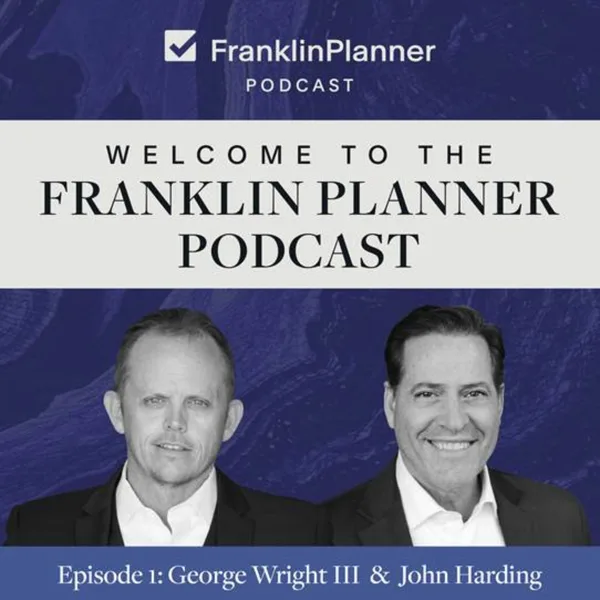
Over 15 million people across 40 years have used the Franklin Planner system to organize what matters most — and yet, as hosts George Wright III and John Harding admit in this inaugural episode of The Franklin Planner Podcast, most of us know these principles far better than we practice them. George, CEO of Evolution Group and a brand builder for 25 years, is joined by John, an owner and board member at Franklin Planner and managing partner at Lightric Consulting.
The episode lays the foundation for everything the show will explore: the history of the planner, Stephen R. Covey's 7 Habits of Highly Effective People, the strategic pathway of vision, mission, and values, and the weekly and daily planning system that turns those principles into action. If you have ever wondered how the Franklin Planner system and the 7 Habits fit together, start here.
Where the Franklin Planner System Came From: Hyrum Smith and Stephen R. Covey
Two names anchor the story. Hyrum Smith founded the Franklin Institute out of a passion for Benjamin Franklin and what Franklin had written about productively leading your life. Within a year that company became Franklin Quest, and the Franklin Planner was born — a paper-based planner and journal system that, as the hosts note, is a tool perfected over decades alongside the trainings that go with it.
The second name is Dr. Stephen R. Covey, who launched The 7 Habits of Highly Effective People on August 15, 1989. John describes the genius of the combination: principles that have been around for hundreds of years, merged with a simple, powerful system for executing them. More than 40 million people have read the 7 Habits; more than 15 million have implemented the planner. The podcast exists to help people put the two together.
Why Timeless Principles Matter More in a Digital World
Are principles written decades ago still relevant in a marketplace that changes every quarter? John's answer is direct.
Here's what doesn't change: humans. Humans don't change. So technology changes.
Digital technology has brought miracles, but it also brings a huge set of distractions and an overload of decisions and information — including information you no longer know whether to believe. George points out that most of the challenges people face trace back to two things: they are not grounded in any direction, and they have nothing but technology to center themselves around. It used to be about information; now it is about applying that information in an ever-changing economy. A journal and planner tied to your intention is how you center yourself.
The 7 Habits of Highly Effective People, in Brief
Before the habits, Covey sets up the idea of a paradigm — how you see the world. Hyrum Smith called it your belief window. John retells Covey's subway story: a father lets his children run wild on a Saturday train until Covey finally asks him to rein them in. The man looks up and says their mother passed away an hour ago. One sentence, and the whole paradigm shifts.
The Private Victory: Habits 1 Through 3
Habit 1, Be Proactive, is taking responsibility for your life and focusing on your circle of influence rather than your circle of concern. Habit 2, Begin with the End in Mind, asks you to imagine yourself at 80 looking back: what would you like to have become and accomplished for the people who matter to you? Habit 3, Put First Things First, is where personal management gets specific — down to what a perfect day would look like. Together these three make up what Covey calls the private victory, the move from dependence to independence.
The Public Victory and Sharpening the Saw
Habit 4, Think Win-Win, is what George calls an abundant mentality: there is enough for everybody, and the focus shifts to solutions. Habit 5, Seek First to Understand, Then to Be Understood, is the leader's discipline of genuinely listening — John compares being understood to oxygen for the soul. Habit 6, Synergize, is creative cooperation that finds a third alternative better than either person's plan. Habit 7, Sharpen the Saw, is balance: mental, emotional, and physical health, because if one area falls by the wayside, the others suffer. John pictures the habits as a tree — roots, trunk, branches — with Habit 7 as the water and sun that brings it all together.
How the Productivity Pyramid Turns Vision Into Daily Action
The Franklin Planner system runs on the productivity pyramid. At the wide base sit your vision, mission, and values — your personal constitution. Above that come your goals, then your week, and at the top your daily actions. Most people go the other way around, John notes: they jump straight to productivity and never get to what is important. Do the heavy lifting on your values first, and the rest becomes a recipe proven over time.
The science backs the practice. John cites Stanford professor Ed Batista's work on journaling and goals: write a goal down physically once, even if you never revisit it, and you are over 32 percent more likely to achieve it. Twenty minutes of real weekly intentionality can change your results.
Even though day by day habits are small things, the impact is giant.
Action Steps
- Over the next 30 days, write down your personal mission or vision — even a rough first draft.
- List who matters most to you and what matters most to you, and keep the list where you plan.
- Pick one of the 7 Habits to practice deliberately this week, starting with Be Proactive.
- Block 20 minutes each week to review your values, goals, and the week ahead in your planner.
- Write at least one goal down by hand — that alone puts you in the small percentage who do.
The hosts' single goal for the podcast is simple: to help. Life does not have to be so difficult when you are intentional. You don't just manage time. You lead your life.