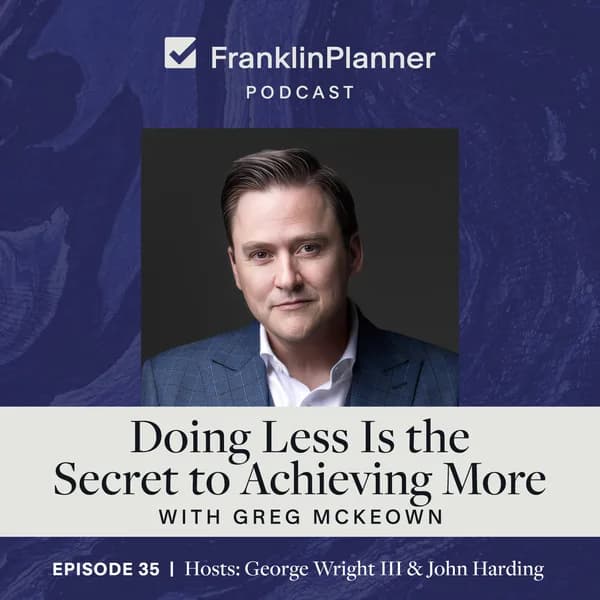
Most productivity advice assumes the problem is that you aren't doing enough. Greg McKeown has built two New York Times bestsellers — *Essentialism: The Disciplined Pursuit of Less* and *Effortless: Make It Easier to Do What Matters Most* — on the opposite premise. On this episode of The Franklin Planner Podcast, host George Wright III sits down with McKeown for an Author Spotlight conversation about why modern life leaves us feeling seasick, why your calendar app will never save you, and why understanding other people may be the missing skill behind every priority you've ever set and failed to protect.
Greg McKeown on Why We're Disoriented, Not Just Distracted
Ten years ago, when McKeown published *Essentialism*, the villain was distraction. Today, he argues, we've crossed into something different. "We're not distracted anymore, we're disoriented," he told George. The sensation isn't just information overload — it's emotion overload, and the best single word for it is noise.
Trace the word *noise* back to its roots and you land on *nausea*. What people feel is a kind of seasickness: a disconnection from the basic orienting questions of a life. Where am I? Where do I want to be? How do I get there? What's holding me back? When you experience the world through an endless scroll of disconnected video shorts, those questions never get asked, let alone answered.
We need something outside of technology to be able to help us orient again back to what matters most.
Why Technology Was Built on the Wrong Assumptions
If digital tools were supposed to help us focus on what matters most, why are so many people busier than ever and less productive? McKeown's answer goes underneath the apps. Every technology is built on assumptions, and if those assumptions are wrong, every tool built on top of them inherits the flaw.
His example is email. Twenty years into a world consumed by it, you still can't truly prioritize your inbox. The original design was built through the lens of productivity, not prioritization. George added his own version: calendars are designed so you can set it and forget it, when intentional living requires you to think about it on purpose.
McKeown goes further. The device in your pocket isn't a phone — it's closer to a three-trillion-dollar disorienting machine whose owners get paid when you're unsettled. That violent video that shows up in your feed from an account you don't follow? Keeping a user in a state of alarm keeps them watching. "It's not a bug," he said. "It's a feature."
Essentialism: The Disciplined Pursuit of Less
The alternative to the undisciplined pursuit of more starts with a paradigm shift. Success creates options; options create overwhelm; overwhelm leads to a plateau or an outright collapse. Essentialism, McKeown stresses, "isn't about productivity, it's about prioritization" — not prioritizing now and then, but viewing your whole life through that lens until you don't just *do* essentialism, you become an essentialist.
If You Don't Prioritize Your Life, Someone Else Will
He learned it the hard way. Years ago, a colleague emailed to say that Friday between 1:00 and 2:00 would be a bad time for his wife to have a baby, because he was needed at a client meeting. His daughter was born in the early hours of that Friday — and he still went to the meeting, laptop open, phone on, telling himself that if he could do it all, he could have it all.
It's obvious I made a fool's bargain. I violated something essential for something non-essential.
Confident Misunderstanding: Why Prioritizing Fails Around Other People
After a decade of teaching this material, McKeown reframed the question entirely. The hard part isn't prioritizing — it's living as an essentialist *in a world of people*. The bottleneck isn't talent, strategy, execution, or effort. It's what he calls confident misunderstanding.
He points to a 1990 Stanford experiment by PhD student Elizabeth Newton. Eighty participants were split into tappers and listeners; tappers chose from 25 well-known songs and tapped out the rhythm. Tappers predicted a 50% success rate. The actual result was 2.5% — three out of 120 trials. A 20X gap between expectation and reality. We're confident we're being understood, and we're almost never right. That gap makes shared clarity nearly impossible, and shared clarity is what lets two people make trade-offs together.
The One Conversation Game Worth Learning
We're all playing some communication game already — being right, debating, defending — usually one absorbed in our family of origin and never named. McKeown's move is to announce a new game with a single question: *Would you be open to having a conversation in which the only focus is to understand each other, not to persuade each other?*
The supporting rule comes from Carl Rogers, who in 1952 called it a test-tube solution possibly powerful enough to address the Cold War: you only get to make your point after you've made the other person's point to that person's satisfaction. Rogers called for research; McKeown couldn't find any in 75 years, so he built a Listening Lab to study it. He also notes that Stephen Covey was more influenced by Rogers than anyone — the fifth habit, seek first to understand, is nearly verbatim.
Effortless and the 85% Rule: 10X Results Without Burning Out
McKeown asks audiences two questions. Who wants 10X results in their work and relationships? Every hand goes up. Who can work ten times harder? Nobody. So the only path forward is a different lens, not more effort.
His case study is the race to the South Pole. The British team operated on the belief that maximum effort equals maximum results — sprinting 20, 30, even 50 miles on good days, then collapsing in their tents on bad ones. The Norwegian team had learned sweat management from people who thrived in extreme cold, and turned it into a rule: 15 miles every day, never more. Same brutal weather, steady progress. They reached the Pole more than 20 days ahead — and had enough left to survive the journey home. The British team did not.
Lazy is not being willing to put in effort. Easy is that something doesn't require effort.
The practical translation is the 85% rule: never spend more than 85% today, because you want 85% available tomorrow. McKeown's two vehicles for changing how you see things are reflection — pen, paper, and a protected half hour — and real conversation with people who see the world differently than you do.
Action Steps
- Run a daily power half hour: six minutes of free writing to get the noise out (*what*), then connect the dots (*so what*), then plan (*now what*).
- Use the one-two-three method: one priority for the day, two things that are essential and urgent, three maintenance items that make tomorrow easier.
- Apply the 85% rule to your biggest project this week — stop before you're depleted so you can go again tomorrow.
- Before your next hard conversation, ask: "Would you be open to a conversation where the only goal is to understand each other, not persuade each other?"
- Name the invisible lens you're operating from. Where have you assumed that if it isn't brutally hard, it doesn't count?
Prioritizing alone is necessary but insufficient. It becomes a real life only when you can explain what matters to you, genuinely understand what matters to the people around you, and make the trade-offs together. You don't just manage time. You lead your life.