Most of us don't struggle because we lack ambition. We struggle because the things we care about most — health, family, faith, financial security, purpose — never quite make it onto Tuesday's schedule. In this episode, George Wright III and co-host John Harding walk through one of Franklin Planner's most foundational tools, the Productivity Pyramid, and the simple question it exists to answer: how do the things that matter most to you make their way into your daily life?
It's a model John learned directly from Hiram W. Smith, Franklin's co-founder, whose promise was straightforward. Live according to what you value, and at the end of the day you'll feel something rarer than productivity — you'll feel inner peace.
What the Franklin Planner Productivity Pyramid Is
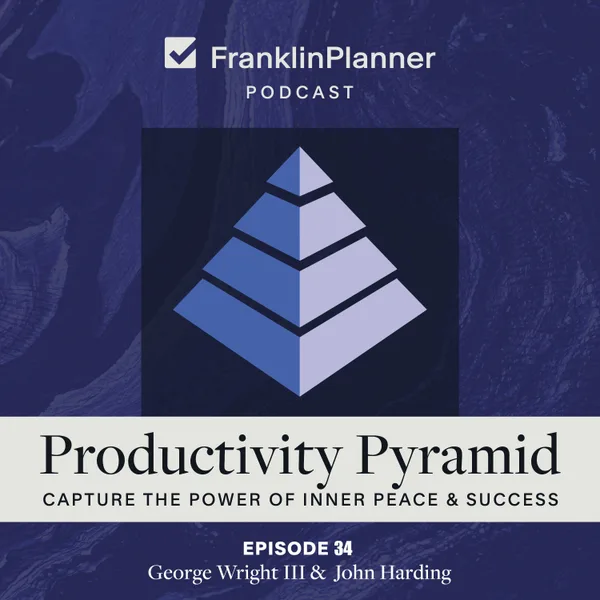
The Productivity Pyramid is a companion tool to the Time Matrix, and it has four levels stacked on a strong base. At the bottom are your governing values — what matters most, along with your vision, your mission or purpose, and your roles. One level up are your goals, short- and long-term. Above that is weekly planning, where goals become real commitments on real days. At the very top are your daily actions.
What makes it powerful isn't complexity — it's the line of sight. Most people plan in reverse: they open a calendar, cram in what's urgent, and try to squeeze what matters into the leftover space. The pyramid flips that. You start with what matters, then build upward until it shows up in what you actually do tomorrow.
How do the things that people say are most important to us make their way into your daily life?
How to Identify Your Governing Values
The phrase "governing values" sounds formal, but John suggests starting with your real life instead of a worksheet. Ask: what people and commitments would I deeply regret losing touch with? Where does my time feel genuinely well spent? What kind of person do I want to become, and what do I want people to think of when they think of me?
Examples might include faith, family, integrity, learning, health, service, craftsmanship, or financial responsibility. But the word itself isn't the point — the meaning underneath it is. "Family" might actually mean *being available to the people who need me and helping them succeed.* That definition is what gives you something to plan around. As George put it, don't overthink this step. You're not writing a manifesto; you're naming what's most important so the rest of the pyramid has something solid to stand on.
When your daily practices reflect your governing values, you experience inner peace. — Hiram W. Smith
Turning Values Into Goals for This Season of Life
A value can endure for decades. The goal that expresses it will change — and should. John's framing is useful here: ask what *meaningful progress* would look like in this season of your life, specific to one of your values.
He offered a personal example. He values health partly because he wants the energy for things he loves, like water skiing with his family. With a little more age, getting up on the ski has become the hard part — so the goal adjusts to the season, even though the value doesn't. Or take the value of connection with family: in one stage, the goal might be a weekly conversation with a child who's moved away. In another, it's regular time with your spouse, or with an aging parent you're caring for.
Two common mistakes show up at this level. The first is setting too many goals at once — the more you carry, the less likely you are to accomplish any of them. The second is choosing a goal that sounds impressive but isn't really yours. That's where Stephen R. Covey's counsel applies: *seek first to understand, then to be understood.* Draw a circle around yourself, identify the people closest to your roles, and let their input sharpen your goals rather than replace them.
Why Weekly Planning Creates Better Daily Plans
A single day gives you a narrow view. A week is the right zoom level — close enough to be real, wide enough to see your commitments, your available time, and the roles that need attention before the days arrive. As John said, the best daily plans emerge from weekly plans. A week gives you room to decide *when* important things can happen.
A Five-Step Weekly Planning Review
John offered a simple process to run at the start of your week, whatever day that is for you:
1. Look back. What moved forward last week, and what needs to be carried over or reconsidered? 2. Review your values and goals. Open your planner and rewrite them — the act of rewriting draws out fresh insight. 3. Look ahead at the calendar. See what's already committed and where the genuine openings are. Time block by morning, afternoon, and evening. 4. Choose a few actions you can schedule and prepare for. 5. Make realistic commitments, leaving room for work, people, and surprise.
If five steps feels like a lot, run a single goal through the process and see what happens.
Daily Planning, Interruptions, and the Time Matrix
Your daily plan is where intention meets initiative — and reality. You review the commitments already on your schedule, pull in the actions you identified for the week, and keep the week in mind as you go. Then the Time Matrix does its work: sorting what's important from what's merely urgent.
Genuine deadlines and immediate problems deserve attention. But the activities that most shape your future usually live in Quadrant 2 — important, not urgent, never demanding your time. The pyramid is what tells you which things qualify as important in the first place, because the answer comes from your values, not from your inbox.
A plan isn't a guarantee that nothing changes. It's a guide for choosing and adjusting. When interruptions come, you ask what truly must be handled now, what can be scheduled, and what can be declined — and those decisions are far easier when you've thought them through in advance.
Anything less than a conscious commitment to the important is an unconscious commitment to the unimportant. — Stephen R. Covey
Action Steps
- Write down a short list of governing values — fewer is better — and define what each one actually means to you in plain language.
- Pick one value and translate it into a single goal that represents meaningful progress *in this season of your life.*
- Run John's five-step weekly planning review at the start of your week, beginning with just one goal.
- Before each day, sort your tasks by important versus urgent, and protect at least one Quadrant 2 action.
- At the end of a day, trace one completed task back through the week and the goal to the value that made it worth doing.
The checkmark matters because of the action it supports, and the action matters because of the value beneath it. That connection is what Hiram Smith called inner peace — and it's available to you this week, with nothing more than a pen and an honest answer to what matters most. You don't just manage time. You lead your life.