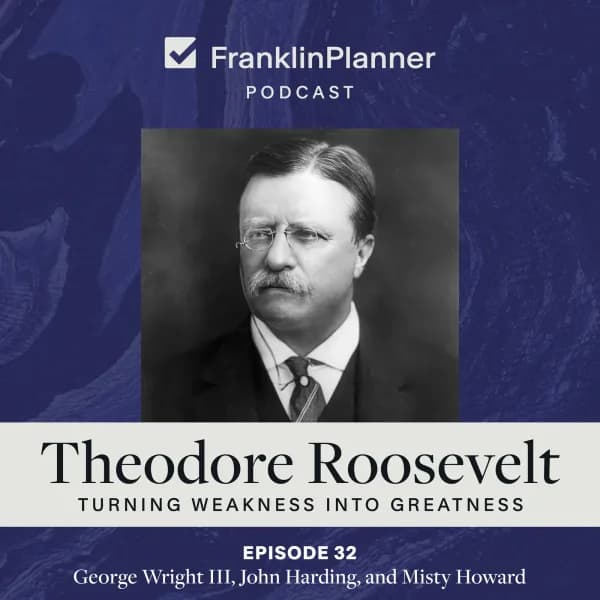
Theodore Roosevelt is carved into Mount Rushmore beside Washington, Jefferson, and Lincoln — but the boy who became that face could barely breathe. On this episode of the Franklin Planner Podcast, George Wright III, John Harding, and resident history expert Misty Howard trace Roosevelt's life as a case study in resilience, character, and leadership, and in a single stubborn idea: you don't get to choose everything that happens to you, but you always get to choose your response.
That distinction is the whole episode. Roosevelt's story isn't useful because he was flawless — all three hosts are quick to say he wasn't. It's useful because at every hinge point, he moved. He engaged the difficulty instead of waiting for it to pass.
We do not choose everything that happens to us, but we repeatedly face the choice of what we will do with what happens.
Theodore Roosevelt's Sickly Childhood and His Father's Challenge to "Make Your Body"
Roosevelt was born into enormous privilege — his father was a wealthy New York merchant and philanthropist — and Misty Howard points out that the family is proof money doesn't insulate anyone from hardship. Young Theodore was thin, frail, and chronically ill. Severe asthma attacks woke him in the night feeling as though he were suffocating. He was so nearsighted that thick spectacles became part of his permanent image.
His father did two things that mattered. He held his son through those attacks with real compassion — and then he challenged him.
Theodore, you have the mind but not the body. You must make your body. It is hard drudgery to make one's body, but I know you will do it.
That wasn't just a demand; it was a vote of confidence. Roosevelt turned his bedroom into a gymnasium and began an exercise regimen he sustained for years. By young adulthood, the frail boy was a strapping, healthy man. The lesson George Wright III draws is practical: don't focus on the problem, focus on the solution — and lean into the strengths you can actually build.
How Roosevelt Rebuilt Himself After Losing His Wife and Mother on the Same Day
At 17, Roosevelt went to Harvard, discovered politics, published a book as a student, and met Alice Hathaway Lee, whom he pursued with the same determination he'd applied to his body. He became the youngest member ever seated in the New York State Assembly and quickly built a reputation for defending working people.
Then, on February 14, 1884, it collapsed. Two days after his daughter was born, his mother died at three in the morning and his wife, Alice, just 22, died that same afternoon. Roosevelt — a prolific journaler — drew a black X across his diary page and wrote one line: "The light has gone out of my life." Then he wrote nothing for weeks.
The Dakota Years and the Strenuous Life Philosophy
Roosevelt went west to the Dakota Territory, leaving his infant daughter in his sister's care. Misty Howard is careful to note this wasn't simple escape. He had loved the West long before his grief, and he was a man who found purpose in a hard new challenge. Locals assumed the New York city slicker turned cattleman wouldn't last a season. He outlasted them — and the quote she offers fits perfectly: "Trials introduce a man to himself."
Those years between 1884 and 1887 produced his life philosophy, the Strenuous Life: greatness is found in facing hard things on purpose, not avoiding them. Roosevelt later said flatly that he would never have become president without his time in North Dakota. John Harding's takeaway is one you can use this week — in a season of pressure, turn toward something you genuinely love. An interest often points straight at a value, and values are what carry you forward.
From the Rough Riders to the Square Deal: Character Over Convenience
Back in New York, Roosevelt remarried — childhood friend Edith Kermit Carow, with whom he had six children and who proved to be the partner his political career required. He campaigned for William McKinley and was rewarded with the post of Assistant Secretary of the Navy. Then the Spanish-American War broke out over Cuban independence after the explosion of the USS Maine.
Roosevelt held a comfortable, powerful, perfectly safe job. He left it. If he was going to ask men to risk their lives for a cause, he reasoned, he had to be willing to do the same. He helped form the First United States Volunteer Cavalry — the Rough Riders — and led from the front in the charge up San Juan Hill. He came home a national hero. Courage, in his case, wasn't a speech.
He entered an era of politics defined by machine bosses, money, and influence. As he rose toward the New York governorship, Republican boss Thomas C. Platt figured the young man could be managed. Everyone learned quickly that nobody told Theodore Roosevelt what to do. He fought corruption and monopolies so effectively that the bosses tried to bury him in the vice presidency — a job Roosevelt described as being everything at any moment and next to nothing until then. Days after McKinley's assassination, he was president.
As president, he governed by the Square Deal and its three Cs: control of corporations, consumer protection, and conservation of natural resources. Trust-busting, cleaner food, better working conditions, and millions of acres preserved for people not yet born. John Harding reads all of it as stewardship — responsibility riding along with power, rooted in deep respect for people you'll never meet. He also notes Roosevelt's willingness to let others lead when he could have taken the spotlight. That humility is its own form of boldness.
The Man in the Arena: Why Daring Beats Perfection
Roosevelt made mistakes, and historians still debate plenty of his decisions. That's exactly why his most famous words land so hard. From his Paris speech:
The credit belongs to the man who is actually in the arena, whose face is marred by dust and sweat and blood; who strives valiantly; who errs, who comes short again and again, because there is no effort without error and shortcoming.
Misty Howard's challenge to you is blunt: identify what frightens you most — a habit you've avoided changing, a goal you've kept vague because it terrifies you — and go there. That's where greatness lives. Roosevelt wouldn't promise you the easy life. He'd promise you the strenuous one.
Action Steps
- Draw a line down a notes page in your planner. On one side, list what you can control about your current challenge; on the other, what you can only influence. Then take one action today.
- Name the limitation you're facing right now, and ask the harder question: what part of my response still belongs to me?
- In a hard season, schedule time for something you genuinely love. Treat that interest as a clue to a governing value, not a distraction from it.
- Write down the one thing that scares you most, then commit to the smallest daring step toward it this week.
- Check your motives in any role you hold: are you using the position for yourself, or as a stewardship for the people it affects?
Roosevelt's story is finished; yours isn't. Anchor yourself to your values, plan the next page, and step into the arena. You don't just manage time. You lead your life.