A battleship captain stares into patchy fog and orders an oncoming light to change course twenty degrees. The light refuses. The captain escalates — "I'm a captain." Then, "I'm a battleship." The reply comes back: "I am a lighthouse." The battleship changes course.
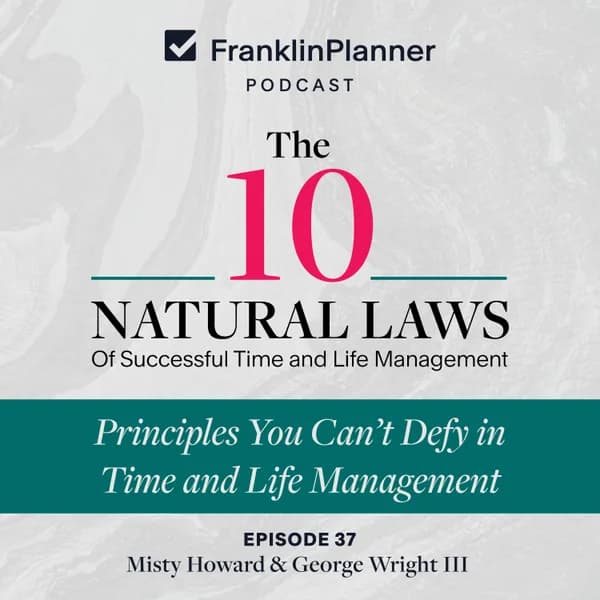
That story, written by Frank Koch and made famous by Stephen R. Covey in *The 7 Habits of Highly Effective People*, is where hosts George Wright III and Misty Howard begin their deep dive into Hyrum Smith's *The 10 Natural Laws of Successful Time and Life Management*. Before you can work through the ten laws themselves, you have to accept the premise underneath all of them: some realities in life cannot be changed, only respected. Rank doesn't move them. Confidence doesn't move them. You either align with them or break against them.
What Hyrum Smith Means by Natural Laws
Misty Howard, the show's resident history enthusiast and storyteller, opens with Smith's own definition — one worth reading slowly, because it reframes everything that follows in the book.
To me, natural laws are fundamental patterns of nature or life that human experience and testing have shown to be valid. They describe things as they really are, as opposed to how we think they are or how we wish they were.
That last line is the hinge. Most of us manage our time against the world as we wish it were — more hours, more energy, fewer consequences. Natural laws describe the world as it actually is. As George puts it, if you want to be successful at time and life management, it begins by recognizing principles that exist whether you want them to or not. A lot of people are working far too hard to build a life while quietly fighting the physics of it.
The easiest example is gravity. Misty tells the story of her seven-year-old niece jumping off a stool convinced she could fly like a fairy — and landing in the emergency room with a broken arm. Hyrum Smith makes the same point more bluntly: a whole group of us could climb to the top of a building and, in defiance of gravity, jump off one by one. We'd all end up as greasy spots on the ground. There is no repealing a natural law. There is only understanding it and living within it.
Why Ignoring Natural Laws Is So Costly
History keeps the receipts. Misty points to the Titanic, which received seven separate warnings about ice. Miscommunication played a role, but so did overconfidence — the belief that this ship would be the exception. It wasn't. Ship meets iceberg, ship sinks. Overconfidence doesn't amend the law; it just raises the price of learning it.
Then there's Franz Reichelt, the Austrian-born tailor who designed a wearable parachute suit he believed would let aviators survive falls from aircraft. He tested it by jumping from the Eiffel Tower. The suit failed and he died. His intentions were good — parachutes would eventually work — but he didn't fully understand the laws governing what he was attempting. Acknowledging a law isn't enough. You have to understand it well enough to respond correctly.
The Flip Side: Laws You Can Use
Every major leap humanity has made is an acknowledgment of these same laws. Engineers building a dam work within them. Aerospace engineers get planes off the ground by obeying aerodynamics, not arguing with it. Misty's favorite example is the Wright brothers, who she's studied in depth: they achieved the first flight not through self-belief alone, but by watching birds, studying the principles already operating in nature, and implementing what they found. Study natural laws and they work *for* you instead of against you.
The Natural Laws That Govern Human Behavior
Here's where this connects directly to productivity. Alongside gravity and genetics, Smith argues, there are natural laws of human behavior — and they are every bit as unbreakable. In his words, if we ignore them they will produce disastrous results, but if we internalize them we can significantly increase our personal productivity and happiness. Defying them, he writes, brings pain and unhappiness as certainly as defying gravity brings injury or death.
Strong language — because the consequences are real. Covey taught the same thing. Fairness, service, and hard work aren't religious ideas or personality preferences; they're universally proven principles. Lying or cheating may produce a short-term win, but centuries of observed human behavior say it eventually costs you.
Principles Are Not Practices — and Not Values
Misty admits that when she first read Smith and Covey, she expected a list of practices: successful people read, successful people wake up early. That's not what these books deliver. Practices are situational — effective in one season of life, useless in another. Principles apply regardless of the situation. Principles also aren't the same as values. Values are deeply personal; they're what matters to *you*. As Misty notes, even gangs share values while violently defying principles. The goal is to build your values on a foundation of true principles. Covey captured the test perfectly:
One way to quickly grasp the self-evident nature of principles is to simply consider the absurdity of attempting to live an effective life based on their opposites. I doubt that anyone would seriously consider unfairness, deceit, baseness, uselessness, mediocrity, or degeneration to be a solid foundation for lasting happiness and success.
The 10 Natural Laws, Previewed
Smith divides the laws into two halves. The first five govern managing your time: you control your life by managing your time; your governing values are the foundation of personal success and fulfillment; when your daily activities reflect your governing values, you experience inner peace; to reach any significant goal you must leave your comfort zone; and consistent daily planning leverages time and increases focus.
The second five govern managing your life: your behavior is a reflection of what you truly believe; you satisfy needs when your beliefs are in line with reality; negative behaviors are overcome by changing incorrect beliefs; your self-esteem must ultimately come from within; and give more and you'll have more. As George observes, the sequence itself is the lesson — the framework moves you from managing your time to managing your life, because that's what people were really after all along.
Action Steps
- Name one area where you're currently arguing with a lighthouse — a reality you keep trying to out-work, out-rank, or out-talk — and change course twenty degrees this week.
- Audit your "seven warnings." What feedback have you received more than once and dismissed because you assumed you'd be the exception?
- Separate your practices from your principles. List what you do because it works in this season versus what's true regardless of season.
- Write down three governing values and ask whether each rests on a principle you could defend out loud.
- Read *The 10 Natural Laws of Successful Time and Life Management* alongside the series, then watch for these laws operating in your own life — Misty's challenge is simple: start looking, and you'll see them.
Self-evident truths don't require your permission to operate. They only ask whether you'll align with them. Understand the laws, build your values on them, and plan your days accordingly — because you don't just manage time. You lead your life.