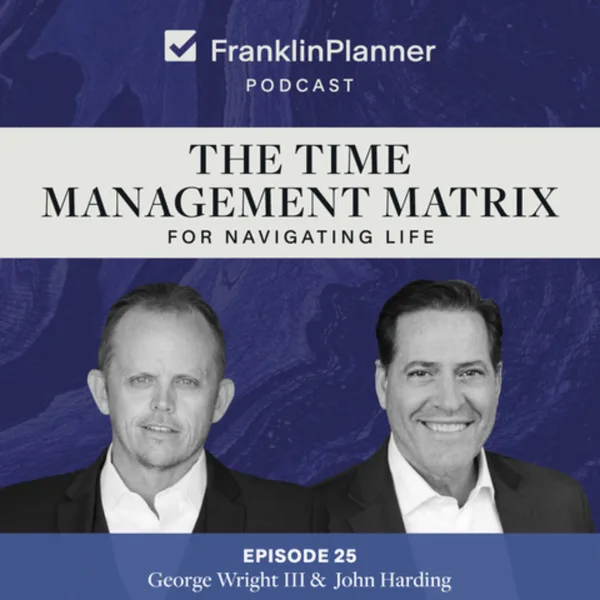
Most people and teams do not struggle because they lack intelligence, talent, or effort. They struggle because the urgent relentlessly crowds out the important. That line opens a new Lead Your Life magazine article, "Why Quadrant Two Thinking on Paper Matters More Than Ever," co-written by Franklin Planner CEO and chairman Bob Sumbot and board member John Harding. In this episode, Harding walks co-host George Wright III through the article and the tool at its center: Stephen R. Covey's Time Management Matrix.
If you have ever ended a day exhausted with nothing important finished, this framework explains why, and it gives you a way out that fits on a single planner page.
Why the Time Management Matrix Is a Rescue From Overwhelm
Harding starts with the research behind the article. Knowledge workers experience dozens of interruptions a day, often more than 50, from email, messages, meetings, alerts, and notifications, and each one takes more than 20 minutes on average for the brain to recover and refocus. The result is more than lost time. You make dozens of decisions about things that do not matter, which produces decision fatigue, and you are buried under information. Harding and Wright have called this overwhelm in past episodes; their newer term is the productivity avalanche.
One finding from the article stood out to both hosts: studies now confirm that the mere presence of a smartphone can reduce available cognitive capacity. Wright's practical test is to check your phone's own screen-time report and see how many times you pick it up. Harding's response to all of it is that the Time Management Matrix is a mindset and a decision filter, and for many people it is oxygen.
The Four Quadrants of Covey's Time Management Matrix
The matrix comes from Habit 3 of Stephen R. Covey's 7 Habits: put first things first. Picture a vertical axis for importance and a horizontal axis for urgency, which creates four boxes.
Quadrant 1 is urgent and important: crises, deadlines, pressing problems. You will always spend some of your life here, and some of it is good, like rushing to help a child. But procrastination and a lack of intentional planning push far more into this box than belongs there.
Quadrant 3 is urgent and not important: interruptions, distractions, and other people's priorities. Harding points out that digital technology does not care about your priorities; it wants your attention. Even people you love and respect will fill this quadrant if you let them.
Quadrant 4 is neither urgent nor important: time wasters, busy work, and escape. Wright names the obvious example, scrolling social media, which usually starts in Quadrant 3 and slides into Quadrant 4.
Quadrant 2 is important but not urgent: planning, preparation, relationships, growth, and renewal. Wright's summary is blunt. If you are living in Quadrants 3 and 4, you are not leading your life.
Why Quadrant 2 Is Where Leadership Lives
Quadrant two is where leadership lives. Quadrant two is where success lives. Quadrant two is where you want to be.
Harding quotes the article on Covey's objective: to lead your life from a center of sound principles, guided by a clear personal mission, while balancing production with the capacity to produce. Covey illustrated that balance with the goose that laid the golden eggs. The farmer wanted more eggs faster and killed the goose. Your health, your relationships, and your planning are the goose. Profit, results, and output are the eggs, and they are only produced by capacity that gets built in Quadrant 2.
Neglect Quadrant 2 long enough and the bill arrives as a health price, broken relationships, diminished creativity, and a life that does not match your intentions. Wright adds that by the time those symptoms show up, you have usually been in the wrong quadrants too long. The matrix gives you a visual way to see where your time is actually going before that happens.
Why Quadrant 2 Thinking Works Better on Paper
The article's title makes a specific claim: paper matters more than ever. Harding is careful to say this is not anti-technology. Franklin Planner has studied this for 40 years, and paper planning is itself a technology, a framework of principles and actions. The brain science behind writing by hand activates a broader neural network that improves memory and depth of thinking. Digital tools push that out, and Harding notes that AI tools can take away some of your thinking altogether.
The digital world is built on interruption. Paper is built for intention, meaningful thought and planning, inspired creation and goal setting.
Paper does not buzz, does not interrupt, creates space, and cannot be hacked. Wright admits his own first reaction to a paper planner was that it would slow him down, hold fewer tasks, and prevent multitasking. Harding's answer is that this is the point. A tool that anchors your attention instead of fragmenting it makes you more productive, not less, because you stop spending energy wondering whether you are on the right track.
Weekly Planning, Daily Adapting
The rhythm is simple. Weekly, you zoom out and plan from your mission, values, and roles, deciding what deserves priority. Daily, you zoom in and adapt, because time treats everyone equally and interruptions will come. The daily page lets you sort what is urgent from what is important and go back to what matters, so you control your schedule instead of the other way around. The same model works in a team meeting: what are we trying to accomplish, and what here is truly important?
How the Planner Unifies Individuals and Organizations
Harding closes by connecting the individual and the company. The Franklin Planner system was never just a calendar, though he refuses to minimize what a calendar makes possible. It is a leadership system that combines a mindset, a strategy, and a structure into a skill set and a pattern. Its rare power is that on the same page, on the same day, a person can hold their personal priorities beside the priorities of their role in an organization.
When individuals are clear on their personal mission statement and understand the organization's mission, vision, values, something remarkable happens. They see alignment, they feel trusted, they offer their best thinking, and they commit with clarity and confidence.
That alignment is where commitment and brilliance come out, and it is why goal setting and follow-through are such an effective answer to overwhelm. Greatness flows outward from the individual to the team to the organization.
Action Steps
- Draw the four quadrants and honestly sort yesterday's activities into them. Notice how much landed in Quadrants 3 and 4.
- Check your phone's screen-time report for how often you pick it up, then keep the phone out of reach during planning and deep work.
- Schedule a weekly planning session on paper, starting from your mission, values, and roles rather than from your inbox.
- Each morning, mark which tasks are truly important versus merely urgent before you respond to anything.
- If you lead a team, open your next meeting with the matrix: what are we trying to accomplish, and what here is important but not urgent?
Harding's invitation, drawn from the end of the article, is to renew your confidence and momentum by mapping out what matters to you on paper. In a world that rewards urgency, that quiet act frees you, lifts stress, and brings a measure of inner peace. You don't just manage time. You lead your life.