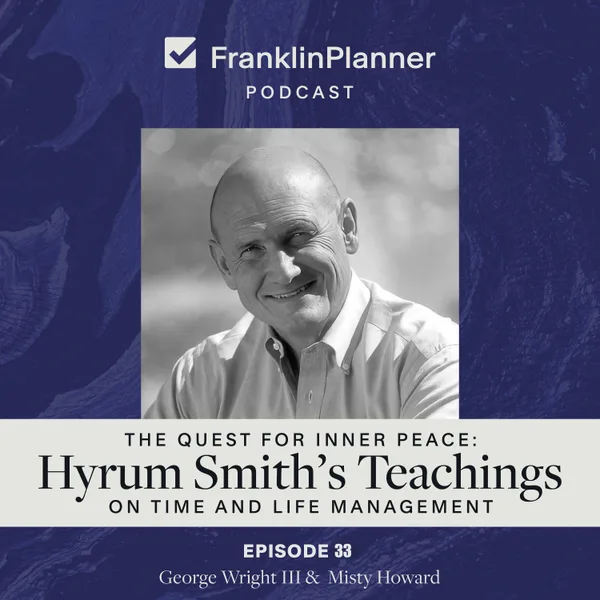
Most people come to time management hoping for a cleaner schedule. What they actually want is to feel better about their lives. That's the premise George Wright III and Misty Howard open with as they launch a new series on Hyrum Smith's book *The 10 Natural Laws of Successful Time and Life Management* — the foundational text behind the Franklin Planner methodology.
Hyrum Smith co-founded Franklin Quest, the company that developed and popularized the Franklin Day Planner before merging with Covey Leadership Center to become FranklinCovey. He taught seminars around the world, and he built his entire system around one idea that has very little to do with squeezing more into a day: inner peace. This first episode covers the book's opening section — "Why Should I Read This Book?" — which Misty calls the thesis statement for everything that follows.
Hyrum Smith on Inner Peace as the Real Goal of Time Management
Smith was explicit that his book was not exclusively about time management. It was about achieving inner peace. That can sound vague until you define it the way he did: inner peace is what you feel when your daily actions line up with what you actually value.
Misty frames the question that pulls people toward a planner in the first place. Maybe you want to get home from work earlier, feel less stressed, stop feeling frustrated. But underneath all of it is something simpler and more universal — you want to feel good about yourself and about your life. Everyone wants to live with meaning and purpose, and everyone wants to feel in control.
I believe that the quest for inner peace and the happiness that comes with it is a life ambition of every person on the planet.
Why the "Age of Time Famine" Makes Efficiency the Wrong Target
Smith cited *Time* magazine's phrase for the modern condition: an age of time famine. People feel perpetually short on hours. They chase new things, compete harder, and end up feeling like slaves to their own schedules — first responders putting out fires all day, then wondering at dinner what any of it accomplished.
Most time management systems answer that feeling with efficiency. And efficiency matters; structuring your day well is a genuine skill. But Misty points out the limitation plainly: it isn't just about shoving a little extra into your schedule. Sometimes we punch the gas before asking whether we're going the right direction at all.
The things that matter most in life are so often held hostage by the things that matter least.
Smith's image for this is the ladder leaning against the wrong wall. You can climb with perfect technique and still arrive somewhere you never wanted to be. Which changes the question entirely — not *how do I fit more into my day*, but *what deserves these hours*.
How Governing Values Close the Gap Between What You Do and What You Believe
If you feel unhappy with your life, there's a good chance there's a gap between what you do every day and what you value. Smith taught that the path to inner peace begins with identifying your core values — what he called governing values — and then honestly auditing your calendar against them.
Make the list. For most people it includes some version of family, relationships, work, health, service, integrity. Then ask the uncomfortable follow-up: how much time do I actually spend on the things I claim to value? If family sits at the top of your list and barely appears in your week, that discord is exactly what you've been feeling. Alignment is what dissolves it.
The Letter That Shows What's at Stake
Smith once received a letter from an executive who had attended one of his seminars. The man had never considered the idea of governing values or whether his schedule reflected his beliefs. When he did the exercise, he found that making a good life for his son sat right at the top — and that he was investing almost no time in that relationship. So he changed it, planning activities with his son and growing close to him over the following year.
Hyrum, last week my son, eight years old, was killed in an automobile accident. I have experienced some real pain at the loss of my son, but I have to tell you that I have experienced no guilt. For the first time since your seminar, I realized what you were talking about when you discussed the idea and concept of inner peace.
How many people reach the end and say *I wish I'd spent more time on* — and then name the one thing they already knew mattered most? Beginning with the end in mind isn't a slogan. It's the whole point.
How Hyrum Smith's Own Values Led to Franklin Quest
Smith lived what he taught. From childhood he described an obsession with making a difference in the world. After college he discovered a talent for selling and marketing, then took a three-year absence to serve a mission for his church — where he realized teaching was what he loved and where he could do the most good.
Coming back, he faced the big question. He was offered a senior executive role at a firm in New York, a lucrative position by any measure. He turned it down, because he didn't believe he could teach from that chair. Colleagues thought he was crazy. Instead, in 1981, he and his family started a seminar company out of their basement. In less than nine years it became a multimillion-dollar company running seminars worldwide, eventually becoming Franklin Quest and producing the planner and tools that followed. Smith looked back at that decision as one of the great turning points of his life — and it came down entirely to governing values.
There's a second lesson buried in that story, as George notes: you discover your unique talents by following what you value, not by optimizing your calendar. This series will continue chapter by chapter, roughly once a month, and the next episode takes on the natural laws themselves — principles that exist outside of us, not tips and tricks. Notice the word *laws* in the title. The Franklin Planner is a tool, and a very good one, but the tool only works when it sits on that foundation.
Action Steps
- Write down your governing values — the things that matter most to you in life. Family, health, integrity, service, work: name yours specifically.
- Audit last week's calendar against that list. Where is the biggest gap between what you say you value and where your hours actually went?
- Pick the single largest gap and schedule one concrete action against it this week.
- Before adding anything new to your schedule, ask "what deserves these hours?" instead of "how do I fit more in?"
- Check your ladder. Is it leaning against the wall you actually chose?
Stop letting your life run you. You don't just manage time. You lead your life.