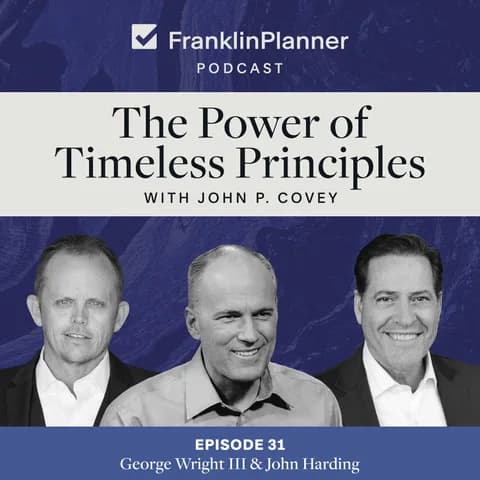
Most of us can name our values. Far fewer can explain the difference between a value and a principle, or why that difference decides the results we get in our marriages, our teams, and our businesses. On this episode of The Franklin Planner Podcast, host John Harding sits down with John P. Covey, nephew of Stephen R. Covey, to unpack the timeless principles behind The 7 Habits of Highly Effective People and how to align your daily life with them.
Covey's background bridges theory and practice. He started out selling and training Franklin Planners for Franklin Quest in Arizona, later taught the Seven Habits, time management, and trust-building around the country, served as a university president and COO, and spent the last eight years with a digital marketing company. He describes his uncle as a man who walked his talk: not perfect, but continuously striving to improve.
John P. Covey on the Difference Between Values and Principles
Values, Covey explains, are 100 percent internal. You get to decide them, whether it's your favorite NFL team, your taste in music, or your politics, and nobody else is right or wrong about them. But values do more than express preference. They drive all of your behavior, moment by moment.
We always do that which we value most in that moment.
That's why a father who says his family is the most important thing but never sees them is telling the truth about his intentions and not his behavior. We judge ourselves by our intentions and others by their actions. Look back over your week and count the moments you actually made your spouse or your kids the most important thing. That record shows what you were valuing.
Principles are different. They are external, and we don't get to decide them.
We are not in control. Principles control. We control our actions that are driven by our values, but the consequences that flow from these actions are controlled by principles.
Gravity is the easy example. You and fifty friends can vote it out, join hands on a rooftop, and step off. Gravity governs anyway. Social principles work the same way, just more slowly. Lie to someone once and they'll likely forgive you. Make it a pattern, and Covey says it's impossible to have a ten-out-of-ten relationship with that person. The relationship survives, but it can never get where it needs to be.
How the Emotional Bank Account Really Works
Stephen R. Covey's emotional bank account is the metaphor for how relationships are built: deposits of trust, honesty, and kept commitments build a balance that can absorb the withdrawals every relationship eventually takes. John P. Covey adds two keys most people miss.
First, it's only a deposit if the recipient considers it a deposit. He learned this the hard way one Mother's Day when he stretched the family budget for a bread maker for his bread-loving wife and got back a polite "Oh, wow, this is great." What she wanted was emotional: a dozen roses every day leading up to the holiday would have been a ten out of ten. Second, deposits must be consistent and frequent. A high school friend you see every five years is one thing; a spouse needs deposits daily, multiple times a day.
The account works up, down, and sideways. How is your relationship with your boss? You decide that, by what you deposit. What does a deposit look like for a coworker, a direct report, or a client? Covey's marketing clients wanted one thing above all: to feel understood.
Why Trust-Based Leadership Outperforms Fear
Fear works. Command and control has driven productivity through most of human history, and Covey doesn't pretend otherwise. But if you want significantly more from people, he points to Stephen M.R. Covey's Trust and Inspire: create a trust-based environment, keep expectations high, and get people's hearts and not just their hands by involving them in solving problems. The result is synergy, where one plus one equals three or more.
He pairs that with the principle of alignment. If your car pulls hard to the right, it isn't out of alignment; it's perfectly aligned to pull right. We are perfectly aligned to get the results we are getting, in life and in business. If you don't like the results, ask what principles are governing them, then change your thinking and behavior to align with the principles that lead where you want to go. Covey's own daily question, ever since a Seven Habits seminar in Phoenix changed his life: what are the principles that will govern this outcome?
The Seven Habits as a Map From Dependence to Interdependence
Covey calls the maturity continuum one of Stephen R. Covey's truly original contributions. Habits one through three, be proactive, begin with the end in mind, and put first things first, are the private victory that moves you from dependence to independence, and the planner is the tool for habit three. Habits four through six, think win-win, seek first to understand, and synergize, are the public victory that creates interdependence. Habit seven, sharpen the saw, is the renewal that makes the rest possible. Written in 1989, the book still powers a thriving company today, Covey says, because it's built on principles that don't change whether you plan on paper or on a phone.
How to Rebuild a Low-Trust Relationship
Asked which principles are hardest, Covey names three: humility and the willingness to change and learn, proactivity (choosing your response instead of flying off the handle), and thinking win-win instead of sliding into lose-win. For daily alignment, he recommends the planner's own routines and Hal Elrod's The Miracle Morning.
For a relationship that isn't where you want it, start with the constraint: get honest about what a withdrawal is for that person, because what you think are deposits may not be. Then experiment. When trust is low, asking "What's a deposit for you?" is itself a withdrawal, so try possible deposits, watch what lands, and stay consistent and frequent. Human relationships, unlike gravity, offer second, third, and fourth chances.
Action Steps
- Review last week and count the moments you made your most important people your most important priority.
- Before any meeting or conversation, ask: what principles will govern the outcome I want?
- Identify what a real deposit looks like for one person in your life, and make it daily.
- If you don't like a result you're getting, name the principle you're aligned with and change the behavior.
- Reread The 7 Habits of Highly Effective People and use your planner to put first things first.
Harding's summary is the one to keep: values are what you choose, principles are what governs, and when you choose to value principles, you raise the odds of leading your life instead of being led by circumstances. As Cecil B. DeMille said of the commandments, we cannot break them; we can only break ourselves against them. You don't just manage time. You lead your life.