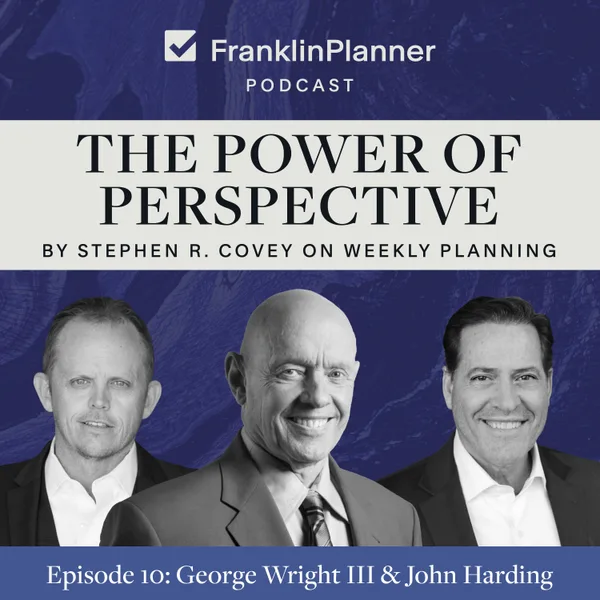
How many of us reach the end of the week feeling busy but not productive? We answered the email, ran from meeting to meeting, checked off boxes — and the things that truly matter never made it onto the schedule. On this episode of The Franklin Planner Podcast, host George Wright III introduces a timeless video lesson from Dr. Stephen R. Covey on the power of perspective and why weekly planning is the foundation of a principle-centered life.
Stephen Covey's Three Lenses: Wide-Angle, Telephoto, and Standard
Covey borrows an image from photography. The wide-angle lens captures the big picture: your life mission, your organizational vision, your long-term Quadrant II priorities. The telephoto lens brings what is immediately in front of you very close: the deadlines, the phone calls, the fires. Most people, Covey says, live as if they were looking through a telephoto lens — hour to hour, day to day, from crisis to crisis, mistaking the urgent for the important.
But you cannot live only in the wide angle either. If you never translate vision into action, you become a dreamer who neglects the details that make the vision come true. The standard lens — a normal human perspective — is the week. It is close enough to be relevant and distant enough to give context. The week is a complete patch in the fabric of life: workdays, evenings, and the weekend. What you can't do in one day, you might do in another, and over a week you can balance your life.
Why Weekly Planning Is Covey's Single Most Powerful Practice
This is Habit 3 of The 7 Habits of Highly Effective People: Put First Things First, the bridge between Begin with the End in Mind and actually living that vision day to day.
If we don't plan our priorities, our priorities will be planned for us.
Covey's answer to which one practice would do more than any other to balance your life and increase your productivity is unambiguous.
Plan your week, each week, before the week begins.
George brings it into today's world of notifications and digital noise, where every ping feels urgent. Twenty or thirty quiet minutes with your Franklin Planner before the week starts reconnects you with your vision, gives structure to your priorities, and helps you say no to distractions that don't align with your purpose. Your planner isn't just a place to store appointments; it is a lens that brings your life into focus.
How to Plan Your Week in Three Steps
Covey's method takes twenty or thirty minutes alone in a quiet place.
First, record your roles — your key relationships and areas of responsibility. You might be a manager of new products, a friend, a community volunteer, a family member. Don't forget yourself; you have an obligation to sharpen your own saw. Organizing around roles keeps the focus on relationships rather than tasks.
Second, choose your big rocks: the weekly Quadrant II goals for each role that will have the greatest impact on your mission and long-range goals. For each role, ask the big rock question.
What is the most important thing I could do in this role this week that would make the most positive difference?
It might be completing the budget, helping a child resolve a problem, or attending a conference to learn what you need for your job.
Third, schedule the big rocks. Block time for them now, before the week fills up, and fit everything else around them. Covey tells of managers at a struggling shopping center who all agreed the one thing that would most improve their business was repairing relationships with their tenants — yet they spent less than 5 percent of their time on it. They set a goal to spend a third of each week helping store owners with their problems. About a year and a half later, the numbers were up and there was a waiting list for new tenants. Once the big rocks are scheduled, you can zoom in each day to prioritize daily tasks and appointments.
Action Steps
- Block twenty to thirty minutes before each week begins for weekly planning.
- Write down your key roles, including one for yourself.
- Ask the big rock question for each role and choose one Quadrant II goal per role.
- Schedule those big rocks in your planner before anything else fills the week.
- Each day, zoom in and prioritize tasks around the big rocks already on the calendar.
With the right process and the right tools, you can organize every week around your deepest priorities without losing the big picture. You don't just manage time. You lead your life.