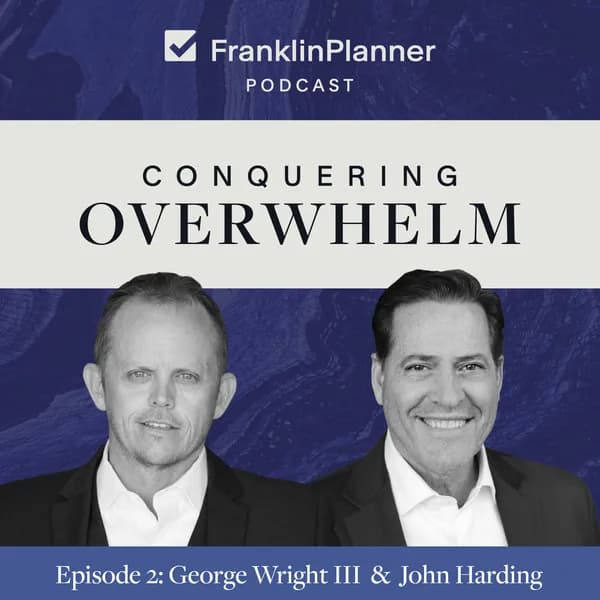
Overwhelm has become the new normal. Endless to-do lists, constant notifications, competing priorities — most of us feel like we are barely keeping our heads above water. On this episode of The Franklin Planner Podcast, host George Wright III sits down with John Harding, owner, board member, and Franklin Planner expert, to break down what is really driving overwhelm and the strategies that actually conquer it.
The conversation goes deeper than time management. As John and George make clear, the way out of overwhelm is clarity about who and what matters most, a daily and weekly structure built around that clarity, and — surprisingly to some — a return to pen and paper.
What Causes Overwhelm? Lack of Clarity, Overcommitment, and Digital Distraction
John starts with a definition. Overwhelm is a state of being emotionally, mentally, and physically overcome by an excessive amount of stimuli, tasks, and challenges, to the point that it feels impossible to manage. It produces helplessness, stress, and anxiety. The root of the word itself carries the sense of being under — almost underwater — and unable to get up.
In most cases, John says, three factors drive it. First, a lack of clarity: people do not have a clear sense of what truly matters to them and who matters to them. Second, overcommitment: Western culture is used to saying yes at work, at home, and in the community. Third, the constant barrage of digital stimuli, information, and decisions that has arrived over the last twenty years.
Digital technology, as powerful as it is for good things, really has no respect for your priorities. It wants your attention now.
That decision-making overload raises stress, and stress drains energy. Decisions, stress, and energy compound — which is why, as George notes, the solution has to be about intention and priorities, not just scheduling.
How to Overcome Overwhelm: Three Actions That Work
Drawing on forty years and fifteen million users of the Franklin Planner system, John lays out the three actions that have helped people break through.
First, truly define who matters to you and what matters to you. In corporate language that is vision, mission, values, and goals; in plain language, it is who you want to be and where you want to go — and, if you lead a team, what you want your team to do.
Second, structure your daily and weekly actions around that first point. The planner industry often says a planner is "more than a calendar," but John wants to give the calendar its due: the rhythm of day and night, week and month, is an unbelievably powerful structure for organizing your life and stepping toward your goals line upon line.
Third, write by hand. The research, John says, is dramatic: handwriting on paper boosts the brain, taps into the intelligence within us, pushes away interruptions, and allows deep work. George admits this shift has changed his own routine — starting the day, week, and year with who and what matters most, then carrying it into handwritten daily and weekly planning instead of running on autopilot.
Why the Private Victory Is Where You Start
Stephen R. Covey spends a great deal of The 7 Habits of Highly Effective People on taking charge of your life before he ever introduces the habits. John highlights the first three — what Covey calls the Private Victory — because they speak directly to overwhelm. Habit 1, Be Proactive: take responsibility for your actions and your life. Habit 2, Begin with the End in Mind: define who you are, where you want to go, and what your goals are. Habit 3, Put First Things First: focus on what is important while still effectively handling what is urgent.
George connects the order to the feeling of being pushed under. If you are overwhelmed, your Private Victory is where you start, because you are the one who creates your life. He points to Michael Phelps — 28 Olympic medals, 23 of them gold, eight in Beijing alone — who used visualization and goal setting to get there. John's takeaway: know where you are going, visualize it regularly, write it down, and work toward it. The same principles apply at scale to a team that knows its purpose and writes it down together.
Paper Planner vs. Digital: What the Research Says
People often say they do not have time to plan. John's response is blunt.
Planning doesn't take time. It saves time.
George adds that the "out of sight, out of mind" convenience of digital tools works against you: when you take something off your plate, other things fill in, and you get more overwhelmed. Handwriting, by contrast, engages the brain in unique ways. John's quick list from the research: paper planning improves memory and retention, boosts creativity, reduces stress, and increases goal achievement. Paper does not distract you with notifications, and — as John jokes — a planner cannot be hacked.
There is a coaching benefit too. Writing things down is a form of what Stanford's Ed Batista calls self-coaching: you stand back, write, think, and improve. And once a goal is on paper, your brain immediately begins solving for it. As George puts it, you cannot multitask while you write, so it forces focus.
Action Steps
- Write down who matters most to you and what matters most to you before you plan anything else.
- Structure your week and each day around those priorities, not around whatever pinged last.
- Plan by hand in a paper planner to engage memory, creativity, and focus.
- Say no to one overcommitment this week.
- Start with your Private Victory: take responsibility, define the end in mind, and put first things first.
John's closing challenge is to take control of your life and hit overwhelm head-on.
There's nothing quite as inspiring, quite as energizing, as really dreaming about who you can be and what you can do to help and be with those that matter most to you.
Your path out of overwhelm starts with a single step. You don't just manage time. You lead your life.