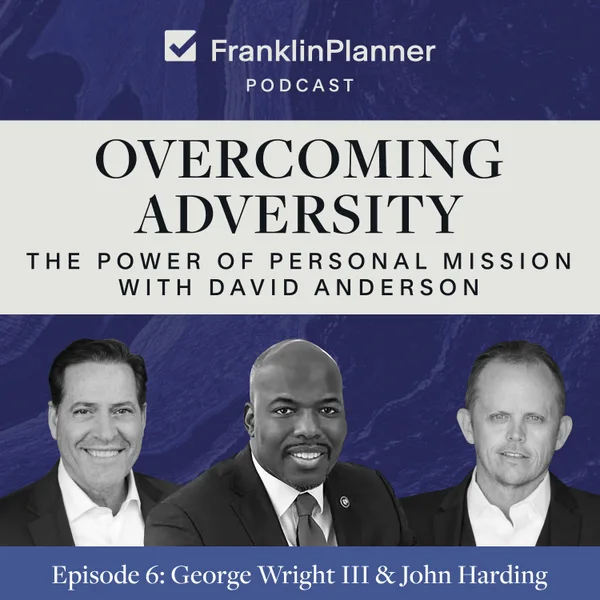
What really drives greatness — talent, passion, destiny? David Anderson has a different answer. As a young man in south Chicago, caring for a mother with schizophrenia and a brother being recruited by gangs, he sat down in his living room and wrote a pledge of allegiance to his own success. He has repeated it thousands of times since, on his way to Goldman Sachs, a TED Talk, and a career as a global entrepreneur and speaker. On this episode of The Franklin Planner Podcast, Anderson flew into the studio to join hosts George Wright III and John Harding for a conversation about personal mission, overcoming adversity, and why the decision to lead your life has to come before the plan.
Harding found Anderson's 2016 TED Talk while preparing an earlier episode on mission, vision, and values, and was hooked within seconds. This conversation explains why.
David Anderson's Pledge of Allegiance to His Own Success
Anderson's family story runs from Mississippi and Louisiana to Chicago, where his mother developed schizophrenia after his brother was born — in the 1980s, long before today's mental health awareness. The divorce and confusion that followed left him navigating what he calls a very broken situation, with neither parent holding a college degree and the streets pulling at his younger brother. One January night he carried groceries a mile home in the cold, and his mother had an episode over turkey bacon instead of pork. He broke down crying in the bathroom, and something shifted.
I pledge allegiance to my success. I pledge allegiance to do my very best. I do believe I will succeed. Nothing will stop me. Nothing will drop me. I have a purpose to fulfill. I have a future that's very real.
He realized that to survive, he needed something more than the desire to make money — something core to his soul, an operating system. A spiritual leader, Pastor Al Toledo, had preached about creating a mission in life, and in that moment of trauma it finally resonated. Anderson had grown up reciting the Pledge of Allegiance to the United States. He asked himself what would happen if he pledged to himself first.
Why a Personal Mission Starts With a Decision
The hosts pull out a point that's easy to miss: Anderson didn't know the answers when he wrote the pledge. He didn't know how or where he would succeed. He made a decision to have his life guided by something, and the mission followed. That's the same territory Franklin Planner users cover when they write a personal mission statement, and Anderson is clear that missions are personal — your faith practice is a guiding light for how you live, but your mission practice is what you do every day in your living.
He couldn't change his mother's mental health or get out of the neighborhood. All he could change was what was inside himself, which is exactly what Viktor Frankl discovered in a concentration camp. Anderson also names something subtler: the programming. Every stereotype about where you're from and what you must be like is a story you have to unprogram, and the only way to do it is by speaking to yourself and writing things down. Then, as Stephen Covey describes in *The 7 Habits of Highly Effective People*, you start collecting private victories nobody else sees — the moment you notice you didn't complain, didn't quit, found a solution instead.
How David Anderson Went From Chicago State to Goldman Sachs
Anderson responded to the pressure by educating himself. Over the next four years he read roughly six hundred books, many handed to him by mentors, while working three jobs — an early shift at Starbucks, a character education program in city schools, construction labor — and then coming home to walk his sister through her homework until midnight. He read on the bus, because he knew he was going somewhere.
At Chicago State University he wanted finance, and the beacon of finance was Goldman Sachs. The career office told him flatly that you can't get to Goldman from this school. He got in through a Harvard pilot program for state-school students, then an interview, then eleven interviews in New York in a single day.
If you give me this shot, I guarantee you there's nobody you will interview or have interviewed that will want this more than I do.
They believed him. He became the first person from his university to land at Goldman — during the height of the Great Recession. His point isn't the prestige. It's that people will always doubt what's possible, and every bridge, car, and first was created by somebody who committed anyway.
Teaching His Sister the Pledge
Anderson's sister was reading at a fourth-grade level in seventh grade, passed along under No Child Left Behind. He told her they were going to catch her up and that she would pledge allegiance to her success — not for straight As, but for giving everything she had. Years later, after a schizophrenic breakdown of her own during her senior year of college, she came back to him and said, "I pledge allegiance to my success. I can finish this." She walked across the stage.
Why Your Mission Is an Anchor in a Distracted World
With Facebook, Instagram, TikTok, WhatsApp, and nine or ten inboxes grabbing your attention daily, Anderson says most people forget to anchor themselves — and if your core operating system isn't intact, you can't respond to any of it well. He compares an unanchored life to a boat left sitting on the water: it goes wherever the tide takes it. Drop an anchor heavy enough and the waves come and go while the boat holds its position. That's what a written mission and a planner did for him. Whatever hit — money, teenagers, aging parents — his goals for the week were still on the page.
He also shares a deathbed study he read years ago: people wished they had risked more, reflected more, and done more that lived beyond them. Reflection is built into the planner, he notes — looking back over a week or a year and seeing what you actually did. Legacy, for Anderson, means his four children seeing a father worth imitating, and a school district of some ten thousand kids now using his pledge to stay off the streets and get to college.
Action Steps
- Write your own pledge. Start with one line you can believe today, as Anderson did, and add to it over the following days.
- Say it out loud daily. Anderson estimates he has repeated his thousands of times, and repetition is how you unprogram old beliefs.
- Identify one thing you can't control and one thing you can, and put your energy entirely into the second.
- Build a reflection habit: review your planner pages weekly and notice the private victories nobody else saw.
- Take Anderson's challenge and set an audacious goal beyond yourself in the next two weeks — his is committing an hour a month to mentor someone who has been asking for his time.
Anderson's story doesn't end with a title; it ends with a daddy-daughter date system he built into his plan so his daughter always knows her dad cares, even when he's busy. That's the point of an anchor. You don't just manage time. You lead your life.