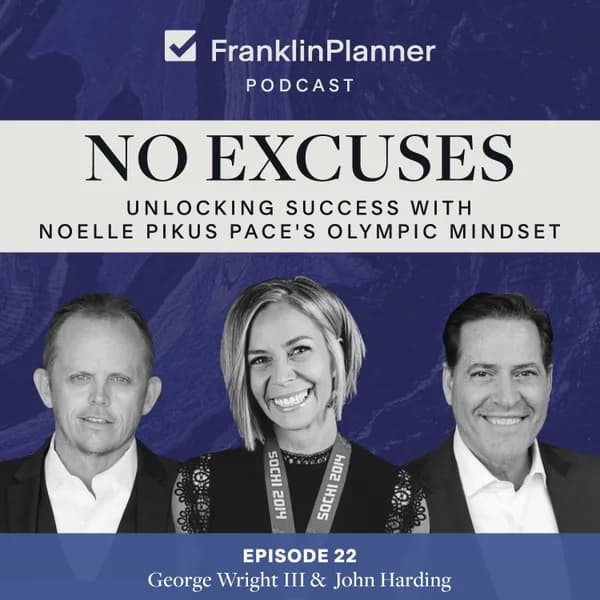
Noelle Pikus Pace was ranked first in the world in skeleton, months from her first Olympics, when a bobsled flew out of the track and shattered her leg. Nine years later she crossed the finish line in Sochi with an Olympic silver medal and jumped straight into the stands to reach her family. In this episode of The Franklin Planner Podcast, host George Wright III talks with the two-time world champion, 26-time World Cup medalist, global speaker, and author of No Excuses about what happened between those two moments.
The story is dramatic, but the lessons are quiet and practical: know your purpose, own your choices, respect the small margins, and take full responsibility for the next 60 seconds. For anyone who plans a week around governing values, it is a masterclass in leading your life.
Noelle Pikus Pace on Purpose and Identity After a Devastating Injury
Pikus Pace got into skeleton, she says, by being tricked into it. A high school track coach sent her to try bobsled, the program lost its funding a year later, and the coaches handed the athletes what she describes as a cookie sheet and told them to go headfirst for a couple of weeks. The funding never came back. She stayed for 15 years.
In 2005, with the yellow jersey and the Olympics only a couple of months away, the accident flipped her life upside down in a split second. Wright frames it as the ultimate identity crisis for a high achiever whose identity is tied to results. Her answer is that you have to know your purpose, and that purpose has layers. There is a lifelong purpose that withstands the test of time, and there is what she calls purpose in real time: what your purpose is today, this week, or in this season.
The summer before the injury she had sat down and written out a list of why she was competing. She believes that if she had not done that reflection first, the accident would have crushed her. Your career, she says, does not define who you are. It is one piece of a bigger picture.
Why Everything Begins With a Choice in the Next 60 Seconds
Rebuilding confidence, Pikus Pace says, starts with a choice, and the choice is always in the present moment.
We can't control what's happened to us. What's happened is gone, and what's ahead is far in the distance, but we can choose what we do with this 60 seconds ahead of us.
In those 60 seconds you can make excuses, blame others, avoid, procrastinate, or people-please, which she counts as a form of excuse. Or you can choose to be grateful, connect, serve, and elevate. Taken 60 seconds at a time, those choices carry you where you want to go. That is exactly the mindset behind her book, No Excuses, which she wrote after realizing she was making excuses about not having time to write a book about excuses. Her solution was to park the family's 1999 motor home at her parents' house across the street and use it as an office from morning until sunset until it was done.
Losing an Olympic Medal by a Tenth of a Second
Pikus Pace came back for the 2010 Olympics as a new mother who had missed her daughter's first birthday, first steps, and first words. She finished fourth, a tenth of a second off the podium, and walked away smiling because she was burned out and, in her words, her purpose was misaligned. Months later she watched the film and saw her shoelaces dragging the entire mile-long run while every competitor in medal contention had zippers covering theirs. Her coach confirmed it: yes, the shoelaces could have cost her the medal.
Her takeaway is about margins. Legacy is not built on one big impactful moment; it is built on the little things you do every single day. If you are not regularly asking what went well, what did not, and how you can be a little better, small decisions quietly put you on the wrong path.
Process Oriented, Results Driven
The 2014 comeback was different because the whole family was aligned. Her husband, Janson, designed and built her sled, and they traveled through airports and hotel rooms with kids ages six and two. At the start line for her final run in Sochi, she had let go of the need to control outcomes and focused only on the next corner and the next step. Her coach's constant instruction was to be process oriented and results driven.
Before I even pushed off that starting line, I knew that success would not be defined by a color of a medal or by someone else's interview, or their words or what they said.
She defined success for herself as her effort and preparation, which is why she says she did not lose gold; she won silver. For planners who set goals, that distinction matters: define what a win means before the week starts, and give yourself credit when you deliver your best.
The Friction Factor and the Corner Four Problem
Pikus Pace teaches what she calls the Friction Factor with a bell curve. Too little friction and people disengage, drift into comfort, and become dreamers with no deadline to move them. Too much friction and they hit overwhelm and burnout. Excuses show up on both ends. The sweet spot in the middle is ownership: owning mistakes, apologizing first, having the hard conversation, painting the wall you have walked past for a year.
Most leaders she works with today are on the burnout side. Her diagnostic comes from crashing repeatedly in corner 12 at Park City. Her coach calmly walked her backward through corners 11, 10, and down to four, where the real mistake was.
You're feeling the pain in corner 12. But your mistake is actually happening in corner four.
In life, the burnout you feel in the morning routine often starts with scrolling at night. Wright ties it back to Franklin Planner's core question of what matters most: step back, find the real cause, and get a coach or mentor who can see what you cannot. That takes humility and vulnerability, which Pikus Pace calls the key to any real growth.
Action Steps
- Write out why you are doing what you do, both your lifelong purpose and your purpose in this season, before the next setback tests it.
- Define success for your next big goal in terms of effort and preparation, not just outcome, and record it in your planner ahead of time.
- Do a shoelace review: replay a recent loss or miss and look for the small, unglamorous detail that cost you.
- Find your corner four. Trace one persistent point of pain back to the earlier habit that actually causes it.
- Take 60 seconds right now to do the nagging thing you have been putting off, whether it is a text, a phone call, or a task.
Pikus Pace's single message is that the next 60 seconds matter. It took 60 seconds to run from the start line to the finish in Sochi, and it takes 60 seconds to make the next honest choice. Choose it, then choose it again. You don't just manage time. You lead your life.