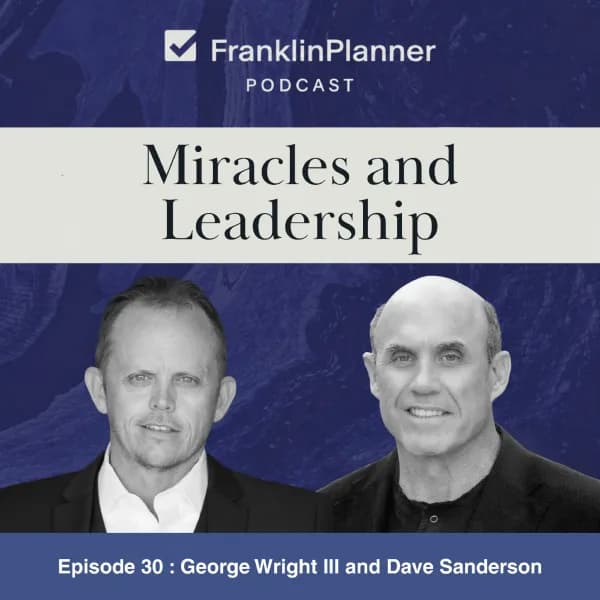
On the Franklin Planner Podcast, host George Wright III sits down with Dave Sanderson, best known as the last passenger off US Airways Flight 1549, the "Miracle on the Hudson." John Harding is not present for this episode, but the conversation carries the same mission the show is built on: helping people lead their lives with intention. Sanderson walks through the crash landing, the chaotic evacuation in 36-degree water, and how that day became the turning point that reshaped his career, his priorities, and his understanding of resilience.
The Miracle on the Hudson: What Really Happened After Landing
Sanderson describes the flight as ordinary until an explosion rocked the plane about 60 seconds after takeoff. The pilot circled back toward LaGuardia, realized he could not make it, and brought the plane down on the Hudson River. Sanderson is careful to separate the story into two parts: the landing, which the pilot rightly gets credit for, and the evacuation, which he calls a team effort. Water poured in immediately, and Sanderson found himself waist deep for seven minutes holding onto a lifeboat that was tethered to the plane, something no one on board initially realized. He credits his parents for teaching him to swim, a skill that ultimately got him off the sinking aircraft.
His mindset during the descent came down to three words repeated silently: aisle, up, out. He explains that repeating a plan enough times moves it from your head into your body, so when the moment came, he did not have to think, he simply acted.
Why Resilience Is Built Long Before the Crisis
One of Sanderson's core teachings is that resilience is not something you suddenly discover in a crisis, it is something accumulated over a lifetime. He points to 12 specific moments in his life before the crash that gave him reference points to draw on that day.
One of my definitions of resilience is most people think resilience is to bounce back, which I think is that's part of it, but you build resilience through your life.
This idea became the foundation for his book Moments Matter and for the coaching frameworks he now teaches leaders and sales teams.
The Four Freedoms That Led Him Out of Corporate Life
The crash exposed a harder truth for Sanderson: he felt undervalued at Oracle. The day he returned to work, his manager's first comment was about an upcoming trip, not his survival. That moment convinced him he needed to leave, but golden handcuffs made it difficult. He identified four freedoms he was missing: freedom of time, freedom of money (despite being Oracle's top salesperson that year), freedom of mission, and freedom of relationships. It took roughly two and a half years, with coaching from Tony Robbins, before he finally left corporate life in 2013.
Proximity Is Power: Lessons From Mentorship
Sanderson credits two major mentors for shaping his thinking: Bill, a 90-something former business owner who mentored him for 13 years starting in 1983, and Tony Robbins, whom he served as head of security. From Robbins, he took the phrase "proximity is power," the understanding that surrounding yourself with high-level thinkers, whether military leaders, authors, or business masters, changes what you believe is possible. He also emphasizes reframing: the meaning you attach to an event determines your emotional response to it, which is why the same crash felt like devastation to some passengers and a blessing to him.
The VCR Framework for Leading Through Uncertainty
Sanderson teaches a simple three-part framework called VCR: Vision, Capabilities, and Reach.
- Vision: define your big vision and the values underneath it, and hold onto it even when strategy shifts
- Capabilities: ask "who can help me get this done" instead of only "how do I get this done"
- Reach: build genuine access and influence with the people who matter to your mission
- Focus on outcomes rather than actions to build a lifestyle, not just a business
- Identify your single "best next step" instead of trying to solve everything at once
He also stresses that high-performing teams, including the Navy SEALs he has worked alongside, consistently choose trust over competence when building people, because competence can be taught but trust cannot.
Action Steps
- Identify your own "aisle up out" phrase, a short mental script you can repeat until it becomes automatic under pressure
- Audit your four freedoms (time, money, mission, relationships) and name which one is most restricted right now
- Document past moments of resilience in your life so you have reference points ready before the next crisis
- Choose one best next step toward your top priority this quarter instead of trying to plan five years ahead
- Find a mentor and commit to mentoring someone else, so what you learn does not end with you
Sanderson closes with a personal story about his mentor Bill, who in 1997 handed him handwritten notes from 1929 on how to be successful and asked him not to let that wisdom die with him. Years later, Sanderson realized writing his own book and speaking to audiences worldwide was how he finally kept that promise. His message to listeners is direct: find a mentor, and mentor someone else, because leading your life well means passing forward what you have been given.