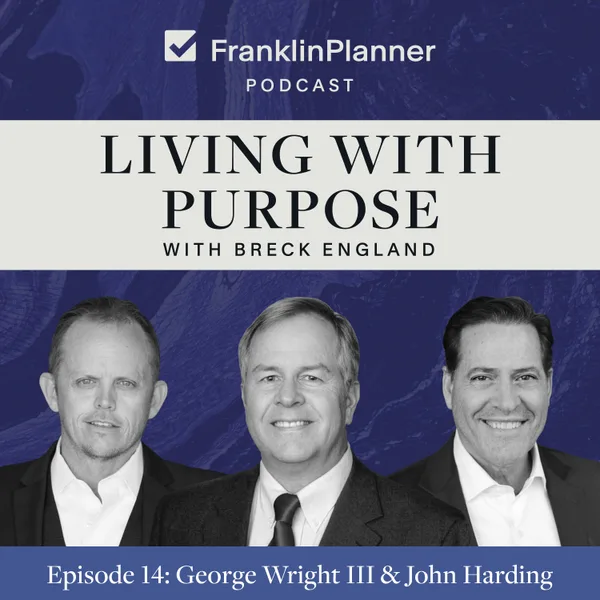
Margot got the promotion she'd hoped for and discovered it was an impossible job. Recruiting, training, scheduling, human resources decisions, an endless stream of complaints from customers and employees, two kids at home, and a husband whose own job kept him crazy busy. She told him she should have been a firefighter, because she spent every day running from one fire to the next. On this episode of The Franklin Planner Podcast, host John Harding sits down with Dr. Breck England, co-author of *The 3rd Alternative* with Stephen R. Covey and a longtime colleague of Harding's at Shipley Associates, Franklin Quest, and FranklinCovey, to walk through Margot's story and the principles that put her life back under her own control.
England, who holds a PhD in English from the University of Utah and has taught the Franklin Planner system for decades, argues that the squeeze most of us feel comes from building our days on the wrong foundation.
Breck England on Margot's Story and the Overwhelmed Life
Before England explains what Margot did differently, he asks four questions of you. What matters most to you, and how will you achieve it? What do you want your life to look like at the end of this year, or in five or ten? How are you deciding, day to day, what to do with your time, or are you not deciding at all? And how do you feel at the end of each day: contented and peaceful, or weary and burned out?
The Franklin Planner system, England says, answers those questions directly. You achieve what matters most, you make your life count in the long term, you control your schedule instead of your schedule controlling you, and your days become peaceful instead of merely busy. For Margot, that started when a friend showed her a small, sleek book and called it her secret. The fires never died out entirely, but the system kept most of them from breaking out.
What Would You Cross the Beam For? Finding Your Governing Values
England describes the Franklin system as a productivity pyramid. The foundation is your governing values. On top of that sit your long-range goals, then the intermediate steps that reach those goals, and only then your weekly and daily plan. Most people invert the pyramid: they start with today's task list and never ask whether any of it matters.
To find the base of your pyramid, England retells Hyrum Smith's I-beam story. A seminar volunteer refused to walk a metal beam lying on the ground for twenty dollars, a hundred, or ten thousand. Then Smith put the beam a thousand feet up between two buildings and held the man's small child over the edge. Would you cross now? Of course.
We all have things we value that are overwhelmingly important to us. The problem is we don't always let that which is most deeply important to us govern what we do.
Margot's answer was one word: quality. Quality of life for her family, quality service for her customers, a quality experience for her employees. England recommends exactly that exercise. Write down one word that sums up what you would cross the beam for, then add a clarifying statement that shows how it cuts across every role in your life. Once you know your burning yes, as Covey called it, you can say no to a lot of things without guilt.
How to Set Long-Range Goals That Actually Get Reached
Reaching a goal, England points out, is mostly outside your control. What you can define is what success looks like and when you want it. His model is John F. Kennedy's 1961 commitment to send a person to the moon and return him safely by the end of the decade. "We're going to lead the world in space travel" would have been useless; it was too vague to focus anyone. A time-bound, precise goal energized a nation so completely that it outlived the president who set it.
Margot did the same thing at a smaller scale. Only about a third of her customers rated their experience a ten, so she set a goal to reach eighty percent within a fixed window. England warns against setting a dozen goals. Choose one, two, or three that flow directly from your foundational values, make them as precise as you can, and put them in writing. Writing clarifies thinking; as the novelist E. M. Forster asked, how do I know what I think until I see what I say?
Why Intermediate Steps Beat Simply Working Harder
Between goals and daily tasks sit what the Franklin system calls intermediate steps: actions you fully control. A salesperson can't promise to close one major sale a week, but she can promise to contact five key clients. A dealership manager who sees twenty cars sold instead of forty has two choices. The phony leader calls every store and says sell more, work harder. The real leader asks what the team can do, within its control, to reach forty, then experiments until something works.
England recalls a CEO who handed every employee a binder of ten company goals; six months later nobody could find the binders, and nobody cared. Setting a goal and achieving it are two different things.
Unless you control your schedule, your schedule will just control you.
How Weekly and Daily Planning Keeps You Focused on What Matters
The top of the pyramid is where the rubber meets the road. Once a week, England says, do what Dr. Covey emphasized for years.
Close the door and everything, and be alone with your planner for 15 minutes or longer. And reread your governing values.
Evaluate your goals. Ask whether your intermediate steps are actually working, and write down the answers. Then schedule those steps into prime time and fit everything else around them. Emergencies still happen, but you delegate what you can and treat them as outliers, not the pattern. Your values, goals, steps, and calendar all sit on the same pages, and as England puts it, the planner will not buzz you, will not distract you, and cannot be hacked.
Paper or Digital? Use Each for What It Does Well
In a bonus segment, England admits his own life blends both. The phone is ideal for messages, quick lookups, and checking the calendar. Paper is better for thoughtful planning, notes that force you to decide what struck you as important, journaling, and what he calls mind and heart work. You can't see the structure of your life on a tiny screen, and phone notes stay fragmentary and ephemeral.
Action Steps
- Answer England's four questions in writing, starting with what matters most and how you feel at the end of each day.
- Write the one word you would cross the beam for, then a clarifying statement showing how it applies across your roles.
- Set one to three precise, time-bound long-range goals that flow from that value, with a clear start line and finish line.
- For each goal, name two or three intermediate steps you fully control and calendar them into prime time this week.
- Close the door for fifteen minutes every week to reread your values, evaluate your goals, and adjust your steps on paper.
England closes with the man the system is named for. Benjamin Franklin wrote down thirteen governing values, spent the rest of his life trying to live by them, and tracked his progress in a little book he called a bold project. That book was his brain outside of his brain. Yours can be too. You don't just manage time. You lead your life.