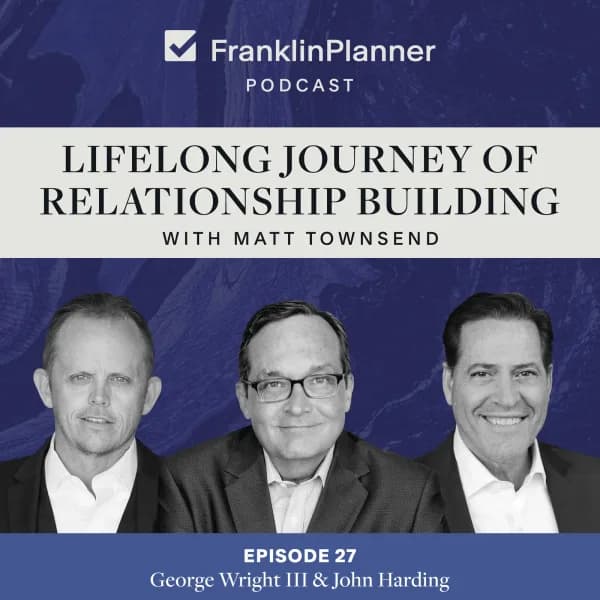
On the Franklin Planner Lead Your Life podcast, host John Harding and co-host George Wright III sit down with Dr. Matt Townsend, a longtime FranklinCovey collaborator and relationship coach, to explore why relationships, not tasks, sit at the center of a well-planned life. Townsend traces his passion back to his parents' divorce when he was eight years old, an experience that pushed him toward degrees in communications and conflict resolution, seven years working alongside Stephen Covey, Sean Covey, and John Covey at FranklinCovey, and eventually a 25-year career coaching couples and mediating divorces.
Why Relationships Belong at the Center of Your Planning
Townsend argues that mission, vision, and goals only matter when they are connected to people. He points to a study showing that about 60% of millennials struggle to deeply connect with their most important relationships, which he says leads people to fight, flee, freeze, or please rather than proactively engage. Roles, he explains, are especially important right now because many people no longer buy into traditional institutions like marriage, religion, or steady employment, leaving them unsure which roles to invest in. Reconnecting a role to your highest values, he says, turns everyday responsibilities into your deepest form of personal development.
relationships are how you do your deepest and highest development. That's kind of the old age old quote by Steven, right? Like, or, you know, we climb the ladder of success one rung at a time. And when we get to the top, we find out it's against the wrong wall.
The Two Years to Two Hours Exercise
To help people identify who and what matters most, Townsend recommends a sifting exercise: imagine you have two years left to live and ask what you would do and who you would spend time with. Then shrink the timeframe to two months, two weeks, two days, and finally two hours, watching how the circle of important people and activities narrows each time. He suggests leaders apply the same exercise to teams, asking what they would prioritize if they had only two more years, or even two more weeks, working together. Pairing this with a "tribute" activity, imagining what you'd want your children or grandchildren to say about you, helps sharpen your conscience around what truly matters.
The Four Lights Framework
Townsend developed his "four lights" questions while teaching a leadership workshop at the LAX Marriott on September 11, 2001, inspired by the story of subway riders escaping the World Trade Center in darkness by following small points of light. The four questions are:
- Self-awareness: What part of the problem or solution am I today?
- Empathy: What are the needs and wants of the people around me?
- Vision: What are my goals and desires in this role or relationship?
- Conscience: What's the most important thing I need to do to have the greatest impact today?
He suggests using these four questions personally during planning, and also as a team tool after a difficult meeting or a tense conversation, giving each person time to answer before moving forward.
Moving From Smoke to Fire in Conflict
Townsend explains that most conflicts get stuck in "smoke," the surface-level argument, rather than reaching the "fire," the real unmet need underneath. He illustrates this with a mediation story about a couple arguing over a $400 purse that spirals into a fight about a golf bag, rounding numbers, and eventually someone's mother, none of which is the actual issue.
To get to the fire, Townsend uses the acronym STARVE, representing seven core relationship needs: safety, trust, appreciation, respect, validation, encouragement, and dedication. Safety includes physical, social, emotional, financial, and spiritual safety. Trust involves both character and competency. Appreciation looks different for everyone, some people need to see effort, others need to hear it or feel it. Respect means being seen and having your ideas taken seriously. Validation means both people get to be right without invalidating each other. Encouragement means someone knows your heart and your dreams. Dedication means knowing someone is more committed to you than to any competing priority.
The Get Real Method for Healing Conflict
Townsend's approach to resolving conflict once you identify a starved need is what he calls "get real": recognize the emotion, explore the story behind it, attend to the underlying need, and lift the conversation. He stresses suspending certainty, even after decades of experience, and going a layer deeper than the first thing someone says. Recognizing emotion tells the other person you see them; exploring their story tells them you hear them; attending to their need tells them you understand them; and lifting the conversation with words like "I agree," "I appreciate," or "I acknowledge" followed by "and" allows you to add your perspective without dismissing theirs.
starved people, a lot of times people aren't starving because you're starving them. They're starving because someone else in their past did, and they don't know how to be fed or they don't know how to trust.
Leadership Through Influence and Connection
Townsend closes by connecting relationship skills to leadership itself, noting that to influence someone, you must first be open to being influenced by them. Understanding another person's journey gives you the credibility and insight to help move them forward. He describes the relationship itself, the space between two people, as holding value beyond either person individually, which is what allows a leader and team member to accomplish more together than either could alone.
Action Steps
- Pick one relationship you know is struggling and run it through the four lights: self-awareness, empathy, vision, and conscience.
- Try the two years to two hours exercise to clarify who and what truly matters in your life or on your team.
- The next time conflict arises, pause and ask what STARVE need (safety, trust, appreciation, respect, validation, encouragement, dedication) might be unmet.
- Practice the get real method: recognize the emotion, explore the story, attend to the need, and lift the conversation with "and" instead of "but."
- Revisit your four lights answers daily, then take one small action based on what surfaces.
Relationships are the foundation Townsend keeps returning to, not as a soft add-on to productivity, but as the actual purpose behind the planning. By using tools like the four lights and the STARVE framework, you can turn ordinary conversations into real progress with the people who matter most.