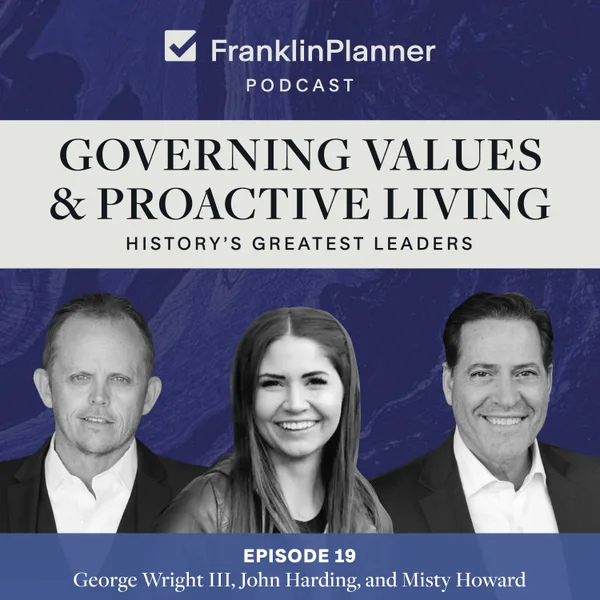
Are you living intentionally, or simply reacting to whatever the day throws at you? On this episode of The Franklin Planner Podcast, host George Wright III sits down with Franklin Planner owner and board member John Harding and historian Misty Howard to unpack what it really means to be proactive. Rooted in Habit 1 of Dr. Stephen R. Covey's *The 7 Habits of Highly Effective People*, the conversation moves from the concentration camps of World War II to a Kentucky cabin with a dirt floor to a British prison ship, and lands on a simple question: will you act, or be acted upon?
The answer, as all three make clear, comes down to governing values, the language you use, and the daily decision to focus on what you can control.
What It Means to Be Proactive: Habit 1 of Covey's 7 Habits
John Harding started with the foundation. To be proactive, in Dr. Covey's sense, is not merely to take initiative. At its deepest level it means recognizing that as human beings we are responsible, and that we have the ability to choose our response rather than be acted upon. Two people can face the exact same events and respond in entirely different ways, because the difference is never the event. It is the paradigm through which each person sees it.
Misty Howard called it one of the most misunderstood principles, and one that changes your whole perspective once you learn it. Look at the most effective people in history and this quality is always there: a willingness to take responsibility for their own actions and circumstances instead of blaming everyone else.
I actually have the power to control my circumstances by controlling my reaction to them.
Viktor Frankl and the Last of the Human Freedoms
Misty's first historical example was Viktor Frankl, the Austrian neurologist and psychologist whose specialty was helping people find meaning when they were at the end of their rope. Trained in a Freudian tradition that said your upbringing and circumstances program you, Frankl found himself a prisoner of the Nazi regime during World War II. He lost his wife, his mother, and his father.
In the middle of that horror, sitting in a room with no control over anything around him, Frankl discovered what he called the last of the human freedoms: the ability to choose his response between stimulus and reaction. He began exercising his uniquely human capacities, visualizing himself teaching students the lessons he was learning in the camp. That inner freedom made him an inspiration to fellow prisoners and even to some guards, and it became the seed of logotherapy and *Man's Search for Meaning*. As John noted, many of the principles Covey later made practical, including the circle of influence, were pioneered by Frankl in the worst conditions imaginable.
George pointed out the irony: a trained psychologist had his greatest awakening in the depth of despair. If you are in a hard season right now, the lesson from history is that the struggle is often exactly where the awareness comes.
How Proactive Language Changes Your Thinking
One of the most practical parts of the episode was John's contrast between reactive and proactive language. Reactive people say things like "I yelled because I was tired," "I can't change, this is how I am," and "they made me feel this way." Proactive people reclaim authorship: "I choose my response," "I am not my mood," "I am not my habits," "I am not my past." Habits are powerful, John said, but they are not destiny.
Misty added that most of us use reactive language unconsciously all day, saying we have to do things as if we have no choice. Even shifting to "I'm choosing to do this today because I've weighed the consequences" changes the posture. She cited Covey's story of the man who said he had simply fallen out of love with his wife, as though it were a disease that came and went. The proactive alternative is Frankl's line that when we can no longer change a situation, we are challenged to change ourselves.
Words, John reminded listeners, are something you have complete control over, and they shape your thoughts, your feelings, and eventually your actions.
Why Governing Values Anchor Proactive Living: Lessons from Abraham Lincoln
George asked why governing values matter so much to proactivity, and John described them as the core. Proactive people live from the inside out. They decide what they value, what their goals are, and who matters to them, and that inner compass holds when everyone else's agenda comes at them. That is the entire premise of the Franklin Planner: you lead your life by first choosing what governs it.
Values don't eliminate pressure, but they give us a compass through anything.
Misty brought the principle to life through Abraham Lincoln. Born in a Kentucky cabin with a dirt floor, with only about a year of formal education before his twenties, Lincoln refused to walk his father's hard path. His mother believed in him and died when he was nine; his stepmother brought books and urged him to read whenever he could. One of his favorites was *The Autobiography of Benjamin Franklin*. He worked from his circle of influence, and that circle grew until it held a nation.
Just as striking was Lincoln's character. He appointed his rival William H. Seward as Secretary of State and turned him into a friend. He absorbed constant newspaper criticism without reacting, and in his second inaugural address chose forgiveness over triumph, which helped bring the country back together.
To truly have freedom, you have to have complete control of your emotions. If you are ruled by your passions, then you're not truly free.
Abraham Clark's Resolve on the Prison Ship
Misty's second example was Abraham Clark, a signer of the Declaration of Independence. When two of his sons were captured and held on a notorious British prison ship, the British offered to release them if Clark would renounce his allegiance to America. He refused. His sons survived and were eventually freed in a prisoner exchange. George named the word that came to mind: resolve. When your governing values are settled, you do not have to relitigate them every day.
Invictus: A Poem Written from the Hospital Bed
John closed with the story behind *Invictus*. William Ernest Henley, born in 1849, contracted tuberculosis of the bone as a young man, lost a leg, and faced losing the second. Rather than surrender to despair, he wrote from his hospital bed the lines that end "I am the master of my fate, I am the captain of my soul." John called it a very proactive set of words written in a very tough time.
Action Steps
- Listen to your own language for a day. Replace "I have to" and "they made me" with "I choose to" and "I'll find a way."
- Write down your governing values and review them before you plan your day, so decisions flow from the inside out.
- Draw your circle of influence and your circle of concern, then commit this week's energy only to the first.
- Pick one historical figure from this episode and read a biography or, in Frankl's case, his own book.
- Choose one small, values-based response you can practice today, whether you are 25 or 85.
John summed up the Franklin premise that has held for 40 years: there is greatness in every human being, and there is a leader in all of us. As George put it, borrowing Jim Rohn, it is not the direction of the wind but the set of the sails that determines where you go. You don't just manage time. You lead your life.