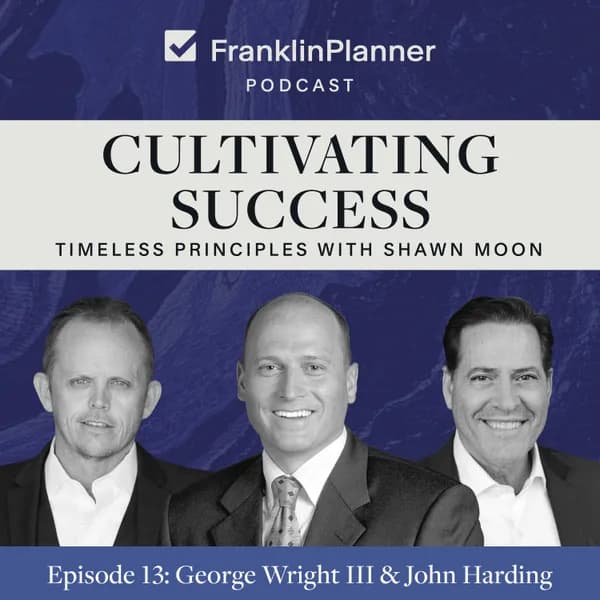
When Shawn Moon asked Stephen R. Covey how anyone could possibly live all seven habits at once, Covey gave him an answer that reshaped his life: don't try to do it all. Do two things. Moon, now chairman and CEO of Zerorez and a former executive vice president at Franklin Covey, has spent more than three decades teaching and living those principles with Fortune 500 companies, government organizations, and leadership teams on every continent except Antarctica. On this episode of The Franklin Planner Podcast, hosts George Wright III and John Harding, who reported to Moon during his Franklin Covey years, ask him what has actually held up.
His answer covers why principles work whether you believe in them or not, the two habits that fix almost everything when you feel off, and what a hundred CEOs told him they want the next generation to know.
Shawn Moon on Why the Seven Habits Are Natural Laws
Moon joined Stephen R. Covey's organization in 1988, before The 7 Habits of Highly Effective People was published, when nobody could pronounce Covey's last name and Moon's job was, in his words, smiling and dialing. The book took the world by storm the next year, and Moon has since watched it work in every language and culture.
That universality is the point. Covey never claimed to invent the principles of effectiveness. They are natural laws, Moon explains, like gravity: step off a tall building and the law governs whether you acknowledge it or not. Human interaction works the same way. If someone keeps demonstrating untrustworthy behavior, you will stop trusting them, as predictably as gravity.
How to Use the 30-10 Rule for Weekly Planning
Here is the first of Covey's two things. Every Monday at 8:00 a.m., Moon has a standing appointment with himself. He reviews his mission, which he has spent years refining, lists the roles he is currently playing (husband, father, CEO, author, consultant, community and church roles), and asks one question for each: what is one thing I could do this week in this role that would make an impact? Those are the big rocks, and he plugs them into his schedule first, before the sand and gravel fill the jar.
Give yourself the gift of 30 minutes once a week.
Then, five to ten minutes at the end of each day, he reviews. What got done? Which big rock dropped because an emergency came in, and where does it get rescheduled? Moon calls it the 30-10, and he says he cannot overstate its power over months and years. When he skips it, the week feels off, like he is not firing on all cylinders. In brain-science terms, Harding notes, the practice pulls you out of the amygdala's fight-or-flight mode and into the deliberative prefrontal cortex. Moon still writes it in a physical planner, because something different happens in his mind and heart when he writes things down.
Why Leaders Need a Framework, a Language, and a Tool
At the organizational level, Moon has seen four things always in play when these principles take hold: a senior team committed enough to model the behavior themselves, a framework, a shared language and set of tools, and leaders at every level who actually live it. When Harding says he is in quadrant two, Moon knows exactly what he means, and that shorthand facilitates communication across an entire company.
What Is the Daily Private Victory?
Covey's second thing is the daily private victory, drawn from habit seven: sharpen the saw. Take time away from cutting the tree to sharpen the blade and you cut faster. Moon frames it as four questions. Physically, am I sleeping, eating, and exercising well? Mentally, am I engaging my brain, or did an hour vanish into reels teaching me six ways to cut a watermelon? Socially, am I deliberately building the relationships that matter? Spiritually, am I reconnecting with my sense of purpose? Thirty to sixty minutes a day, and it need not touch all four.
His favorite example is a big rock that has survived thirty-seven and a half years of marriage: Friday night is date night with his wife Michelle.
Whenever I feel depleted, whenever I feel quick to take offense, whenever I feel edgy or just kind of not firing on all cylinders, I can always trace it back to some failure of my own in habits one, two, and three and habit seven.
Habits One, Two, and Three: Who Owns the Ladder?
Moon's shorthand for personal leadership is a ladder. Habit one says you are in charge of the ladder: between stimulus and response there is a space, and in that space you are free to choose. He learned the lesson at fourteen, on the first morning of high school, when a teacher gave a graded quiz with one question, "Who is the most important person in the world?" Moon wrote "my mom" and got it wrong. The answer was you, not out of ego, but because no one else makes your decisions. Habit two says put the ladder against the right wall by getting clear on what you stand for and what you want to become. Habit three, the 30-10 rule, is climbing the rungs.
When Wright asks what separates effective leaders from ineffective ones, Moon's answer is simple. The ones who fail are sent to a seminar to be fixed and never buy in. They do not break the principles; they break themselves against them. The ones who succeed are willing to step back weekly, ask themselves tough introspective questions, and build their priorities around the answers.
What 100 CEOs Want the Next Generation to Know
Moon's current project is a book built on interviews with a hundred CEOs and executive leaders, including a sitting governor and a member of the British Parliament, each asked one question: if you could pass on a single lesson to the people you love, what would it be? Not one said they wished they had generated more shareholder value. Results matter, Moon insists; no margin, no mission. But the answers are all ways of getting there. The themes are coalescing into twelve categories, among them a spirit of generosity, humility and followership, dignity as strategy, grace in the long game, and, above all, empathy. Moon learned that one the hard way, early in his first big leadership role, when he told his wife he wished everyone could be like him. Leadership means enlisting people so they volunteer their finest efforts.
Covey, Moon says, gave everyone he spoke with the gift of his full presence, and that is the definition Moon carries, with one word added.
Leadership is seeing and communicating another's worth and potential so clearly they begin to see it in themselves.
Action Steps
- Book a standing 30-minute appointment with yourself each week. Review your mission, list your roles, choose one big rock per role, and schedule those first.
- Spend five to ten minutes each evening reviewing what got done and rescheduling any big rock that dropped.
- Claim one daily private victory: something physical, mental, social, or spiritual, for 30 to 60 minutes.
- Write down what you stand for and what you want to become, so your ladder is leaning against the right wall before you climb.
- Ask one person you lead what they need to volunteer their best effort, then listen to understand rather than to respond.
Harding closes with another Covey line: your most important work is always ahead of you. Whatever your age or season, there is great work only you can do. You don't just manage time. You lead your life.