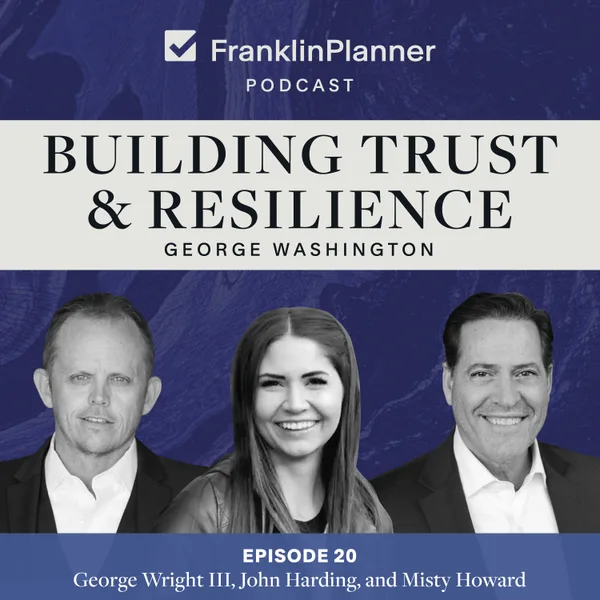
George Washington already had wealth, status, and a home he loved. He chose eight years of war and eight years of the presidency anyway. As the United States marks its 250th anniversary, hosts John Harding and George Wright III sit down with Misty Howard, the show's resident history expert, to ask what the leadership lessons of George Washington still teach anyone trying to lead a family, a team, or a life.
Their answer is that Washington is less a monument than a case study in value-based leadership: duty over ease, service over self, and the rare restraint to walk away from power. Every one of those choices is available to you.
George Washington's Reluctant Path to Command
The popular version of the story paints Washington as a man chasing glory. Howard says his own writings tell a different story. When John Adams proposed him to lead the Continental Army, Washington wrote to his wife Martha that he had used every endeavor in his power to avoid it, both because he did not want to leave his family and because he believed the trust was too great for his capacity. He took the job anyway, relying, in his words, on providence.
He knew exactly what he was signing up for. The colonies were culturally and religiously divided, the army was barely organized, and they were taking on the greatest naval power in the world without a navy of their own. Washington later wrote that no man since the first institution of armies had commanded one under more difficult circumstances. He had, as Howard puts it, pretty much nothing to gain and everything to lose.
So why do it? Washington answered that himself: the establishment of civil and religious liberty was the motive that induced him to the field. That is the first lesson for anyone who uses a planner to clarify governing values. A cause bigger than yourself is not decoration. It is the only thing that carries you when self-interest runs out.
How Washington Built Trust by Sharing the Hardship
Harding, who has visited Mount Vernon roughly ten times, notes that you do not fully grasp the sacrifice until you see the home Washington kept leaving. Howard adds that character is not proven in comfortable seasons.
You don't know who you are until you're put to the test and things get challenging.
Washington earned his men's loyalty by refusing to lead from a distance. He fought from the front so often that his aides begged him to stop rushing forward. He never took a salary during the entire revolution, asking only that his expenses be covered. And he endured the same deprivations his soldiers did.
The clearest test came in 1783, after the war. Officers who had not been paid were threatening to march on Congress, and some wanted to install Washington as a dictator. He gathered them and spoke about civic duty, but the moment that broke the room came when he pulled out spectacles most of them had never seen him wear.
Gentlemen, you must pardon me. I have grown gray in your service, and now I find myself growing blind.
Soldiers wept. The man asking them to stand down had given more than any of them and taken nothing. Wright draws the leadership principle plainly: you cannot step into a role and expect people to follow. Trust is earned over time, alongside the people you lead, and it is what makes the defining moments possible.
Why Long-Term Vision Sustains You Through Valley Forge
Washington lost more battles than he won and still won the war. Howard uses Valley Forge to show what that required. The army had been driven out of New Jersey, Philadelphia had fallen, and Congress had fled. Roughly 12,000 men arrived on a frozen plateau short on food, supplies, and even shoes, while the British enjoyed parties in Philadelphia. About 2,000 of those men died that winter, more than in many battles. At the same time, rivals like Horatio Gates were working to undermine Washington's command.
He used that winter to unite and train his men, and the army left Valley Forge stronger than it arrived. The application to your own planning is direct: you will not win every battle, and setbacks are guaranteed. A leader with a clear long-term vision does not confuse a lost battle with a lost war. Harding connects that to the deep respect Washington held for the people around him; when you give, sacrifice, and refuse to quit, it inspires the people around you to return the same.
Freedom Requires Responsibility and Sacrifice
After victory, Washington was handed the chance to seize ultimate power. Howard says he could have been king. He turned it down, and the reason is the same reason he could calm his officers: it was never about him. He served the American people and the liberties he had fought to secure.
Howard argues the health of a republic rests less on its laws than on the character of its citizens, and that Washington spent his whole life asking what is right rather than what is easiest.
When a person is put into a place where they have heavy responsibilities, they learn to stop asking what is easiest and ask instead what is right.
He died at 67, only two years after leaving the presidency, having spent most of his adult life away from the home he loved. Americans hung his portrait in their houses and elected him unanimously twice. Loyalty like that, Howard says, is born from sacrifice. If you want to inspire the hearts of others, serve them first.
Action Steps
- Write down the cause you care about more than yourself. Howard's invitation is to start there if you want to do something great.
- Audit one relationship or team where you expect loyalty. Ask whether you have gone first in sacrifice and trust, the way Washington did.
- Name your Valley Forge. Identify the current setback you are tempted to read as final, and restate the long-term vision that outlasts it.
- Before your next hard decision, replace the question "What is easiest?" with "What is right?"
- Study Washington's life directly. Howard recommends going beyond the highlights, and Harding suggests visiting Mount Vernon or Valley Forge if you can.
Washington's own closing wish was that the citizens of the United States would make a wise and virtuous use of the blessings placed before them. That is still the question for anyone holding freedom and a blank page for the week ahead. You don't just manage time. You lead your life.