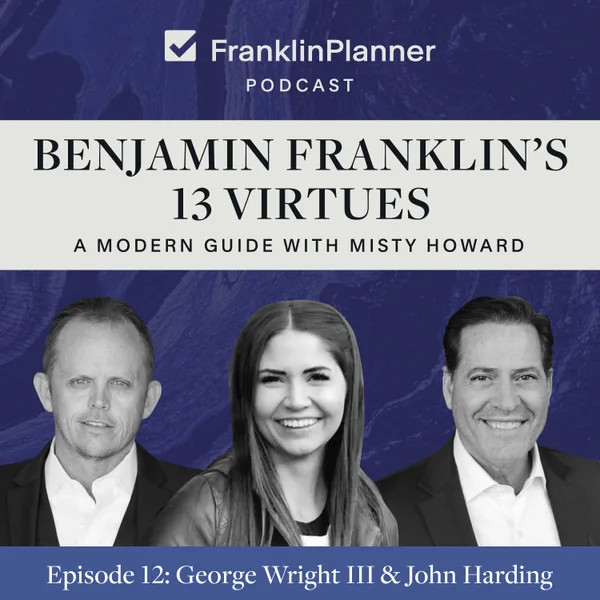
Benjamin Franklin had about two years of formal schooling. He was the fifteenth of seventeen children, bound as an indentured apprentice to his older brother at age twelve, and working long hours in a Boston print shop while other boys his age were still in school. That is not the grandfatherly statesman most of us picture. On this episode of The Franklin Planner Podcast, co-hosts George Wright III and John Harding welcome Misty Howard, a history podcaster and advocate for timeless values who has made it her mission to bring the founding era to a younger generation.
The conversation traces how Franklin went from drifting to deliberate purpose, how his famous 13 virtues grew out of a self-evaluation process, and why that process became the foundation of the Franklin Planner system.
Misty Howard on Benjamin Franklin's Early Years
Howard opens with a pattern she sees across history: the most successful people are rarely born into great circumstances. They are the ones with determination. Franklin, born in Boston in 1706 to a candle and soap maker, is her prime example. He wanted to be a sailor. His father, seeing an aptitude for learning, put him in school instead, then pulled him out when money ran short. By twelve he was apprenticed to his older brother in the printing trade under an indenture that ran until age twenty-one.
What Franklin did with that constraint is the lesson. Frugal with time and money, he packed a lunch of bread and raisins, stayed behind while the other employees went out, and spent the break reading. The money he saved bought more books. He treated writing as the principal means of his advancement, rewriting newspaper pieces to see if he could improve them. At sixteen he was publishing under the pseudonym Silence Dogood, a fictional widow, because he knew his brother would never print anything under Franklin's own name.
His brother also beat him, and Franklin later wrote in his autobiography that this tyrannical treatment planted in him a lifelong hatred of oppression. He could have become a victim of his circumstances, Howard says. Instead he took control, left the apprenticeship, and moved to Philadelphia.
Why Young People Need to Take the Harder Course
Wright and Harding ask what Franklin's story offers young people today. We live in an era of apathy, she says, where youth are taught to take the easiest course and stretch childhood as long as possible. Society loves victims, and it is easy to make excuses based on what we were born into or how other people treat us. The alternative is to take full responsibility and become proactive, so that instead of being shaped by circumstances you shape them.
Greatness is only achieved by taking the harder course.
Harding adds that it is never too young to figure out what matters to you. The habits you build early are the hardest to break, which is exactly why Franklin's turning point in his early twenties mattered so much.
How Franklin's Lost Years Led to His 13 Virtues
In Philadelphia, Governor William Keith promised to send him to England for printing contracts and equipment and to set him up in business. The promises evaporated the moment Franklin landed in London. Between eighteen and twenty, Howard says, he lived through the most directionless period of his life, spending more on amusements than at any other time, forgetting the girl he had promised to marry, and adopting the values of the company he kept.
The turning point came on the long voyage home. Distraction-free and, by his own admission, tired of talking to the people around him, Franklin began evaluating what he really wanted out of life. He was not thinking only about temporal success; plenty of people make money and still feel empty. Franklin wanted a balanced life built on self-improvement and values that outlasted any single achievement. Over the next two years, between ages twenty and twenty-two, he solidified his 13 virtues and, crucially, a system for living them.
The 13 Virtues, in Franklin's Order
Franklin ranked the virtues so that each would make the next easier to practice. Temperance came first, because he believed balance was foundational: eat not to dullness, drink not to elevation. Then silence, order, resolution, frugality, industry, sincerity, justice, moderation, cleanliness, tranquility, chastity, and finally humility, which he added later after someone pointed out his pride. He carried a little book and marked every slip, focusing on one virtue per week so he stayed conscious of his progress.
Governing Values and the Franklin Planner System
The Franklin Planner was not modeled on Franklin's specific list. It was modeled on his self-evaluation process. Harding explains that the productivity pyramid at the base of the system asks you to do exactly what Franklin did on that ship: take time to think about your mission, your vision for the future, your values, and the roles you play. Who matters most to you, in addition to what matters most to you.
Howard adds why that distinction matters. Most time management systems are about doing things faster. The Franklin system is about building a value system and putting your priorities on what matters most. Hiram Smith, one of the company's founders, called the result inner peace. And as Howard notes, the world often tells you success comes at the expense of your values. Franklin proved the opposite.
Our values can actually be the catalyst for our success and lasting success that helps us to feel at peace, not just with what we accomplish, but who we are.
The Link Between Virtue and Happiness
Howard argues that Franklin's greatest discovery was not in science or philosophy but the correlation between virtue and happiness. Near the end of his life he admitted he never reached his goal of moral perfection, yet wrote that the endeavor made him a better and happier man than he otherwise would have been, and he hoped his descendants would follow the example and reap the benefits.
Self-development, she adds, is a means to an end. We improve ourselves so we can help other people, and one of the unalterable laws of life is that we are happier when we are thinking about others. Franklin had a long ocean voyage to reflect. You will have to make that time on purpose.
We have to make time to reflect today. It's not going to happen to you. You have to set aside everything else that's happening in your life and take the time to write down what you truly value in life and the qualities that you want to develop.
Action Steps
- Block out uninterrupted, screen-free time this week to write down what you truly value and who you want to become. Then set goals that move you toward that person.
- Choose one virtue or governing value and track it for a week, the way Franklin did with his little book. Mark the slips without judgment and notice the pattern.
- Ask where you are accepting a victim story about your circumstances, and identify one proactive choice that would begin to shape them instead.
- Take Harding's invitation: share one timeless principle with five people, especially the young people in your life.
Principles do not change, Howard reminds us, and life gets a lot better when we conform to them. Franklin worked at his character in his twenties with no advantages but will. You don't just manage time. You lead your life.