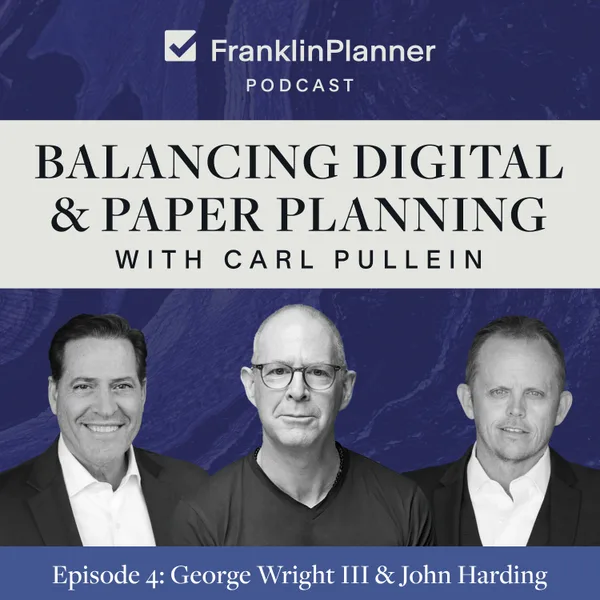
Carl Pullein has spent thirty years studying time management, built a global audience teaching it, and used a Franklin Planner as far back as 1992. Then, like most of us, he went all-in on digital in 2009 — and stayed there for more than a decade. On this episode of The Franklin Planner Podcast, hosts John Harding and George Wright III sit down with the productivity coach behind the Time Sector System and the COD task management system to talk about the experiment that brought him back to paper, and what it taught him about balancing digital and paper planning.
The conversation is not an argument against technology. Pullein runs a blog, a YouTube channel, and a podcast from South Korea, where he has lived for twenty-three years. It's a case for deciding, deliberately, which tool does which job — and for slowing down long enough to plan the life you actually want.
Carl Pullein's Journey From Hyrum Smith to Digital and Back
Pullein's fascination with time management started in middle school, scheduling exam revision with colored pens. Hotel management didn't need it; sales did. After a manager called him the most disorganized person he'd ever met, Pullein picked up Hyrum Smith's *The 10 Natural Laws of Successful Time and Life Management*, and it transformed his life. Governing values had never occurred to him; after the book, he understood that you need a foundation to build your life on, not just a string of reactive days.
He started using the Franklin Planner around 1992. In 2009 he got his first iPhone and joined the digital bandwagon for ten or twelve years. Something was missing the whole time, and about two years ago he finally named it.
Digital technology has no soul. There's no soul to it. It's just, here's a list of stuff you've got to do, here's your appointments, and the text on a screen is always the same.
So in October he bought a brand-new Franklin Planner, set it up, and committed to running it for three months. Six months later, he still hasn't stopped.
Why the Stuff Coming In Will Never Stop
Pullein's clearest teaching point is a story about Queen Elizabeth II, who still did her red government boxes on the morning of the day she died. His takeaway: input is not within your control, but your time is.
Stuff coming in is never gonna stop. Emails coming in: never gonna stop. Slack messages, team messages: never, ever gonna stop. So you can't control it. It's out of your control.
What you can control is what you do with your twenty-four hours. That's why Pullein tells clients to stop trying to manage tasks and start managing their time — and to start with themselves, not their work. If you don't sort yourself out first, you end up unfulfilled and living with low-grade anxiety. It comes back to the question John Harding asks constantly on this show: What do you want? People say they don't have time to think about that. Pullein's answer is that you'll never have time if you don't figure that part out first.
What Is the COD Task Management System?
After reading every twentieth-century time management book he could find, back to the 1950s, Pullein noticed that every great system rested on three moves. Collect: capture everything coming at you in a system you trust — a pocket notebook, a Franklin Planner Satellite booklet, or your phone — so it stops floating around your head and waking you at three in the morning. Organize: run each item through three questions: What is it? What do I need to do? When am I going to do it, if at all? Do: the part most people starve.
Around 2015 to 2017, when productivity apps exploded, Pullein watched people spend 50 to 60 percent of their day organizing. The goal is the reverse: roughly 95 percent doing and 5 percent organizing, which works out to about fifteen to twenty minutes a day. Whether your system is paper or digital doesn't matter; if it's set up correctly, twenty minutes is enough.
What Happened When Carl Pullein Went Back to a Paper Planner
The biggest change was focus. Digital lists become the same text on the same screen all day, and you go numb to them. Sitting down with the planner the night before, away from the screen, forces a few minutes of real thinking about what needs to happen tomorrow. Pullein plans at night because he sleeps better and enjoys the evening more — and when he zips his binder closed, it's a ritual that says the day is done.
Paper Shows You When a Day Is Impossible
His clients were carrying sixty or seventy tasks on a daily digital list. You can't do that in a Franklin Planner; there aren't sixty spaces. And because the day's calendar sits right next to the prioritized task list, seven hours of calls tells you immediately that twenty tasks won't fit.
You can throw a thousand things for your day today, and it's not gonna warn you that this is an impossible day, but your Franklin Planner is doing that.
The results weren't just subjective. When Pullein moved his YouTube planning from digital to paper, his views tripled in a month — from about three thousand a week to ten thousand — with no other change. On paper he was more creative and more fluid with the story; digitally, it had all been bullet points.
How to Balance Digital and Paper Planning
Pullein's landing spot is simple: thinking and planning happen on paper, all the way. Digital wins where speed and communication matter — a scheduling link for coaching clients, a meeting invite with a Zoom link, a quick text to his wife. He still writes key appointments in his planner so he can see the month as a whole and catch overcommitment, and he uses the Notes column on his Monticello monthly pages to list the projects and goals he wants to complete that month. Digitally, those goals always disappeared; on paper, he sees them every Saturday during weekly planning.
He borrows a Navy SEAL saying to explain the split: slow is smooth, smooth is fast. Planning and thinking are the slow part. Execution is fast, and that's where technology belongs. Start your planning on paper; the action steps can go digital as the output of that thinking.
Action Steps
- Pick one collection tool you trust — a pocket notebook, a Satellite booklet, or your phone — and capture everything there instead of holding it in your head.
- Run every captured item through Pullein's three questions: What is it? What do I need to do? When am I going to do it, if at all?
- Plan tomorrow the night before, on paper, and close the planner as a signal that the day is done.
- Write this month's projects and goals in the Notes column of your monthly calendar and review them during weekly planning.
- Decide explicitly where digital serves you (calendar links, communication) and keep thinking and planning on paper.
Pullein's closing advice is the simplest thing he said all episode: slow down. Technology will keep getting faster; your brain won't. The only way to cope is to slow down, figure out what's important to you — not to other people — and plan for that. You don't just manage time. You lead your life.