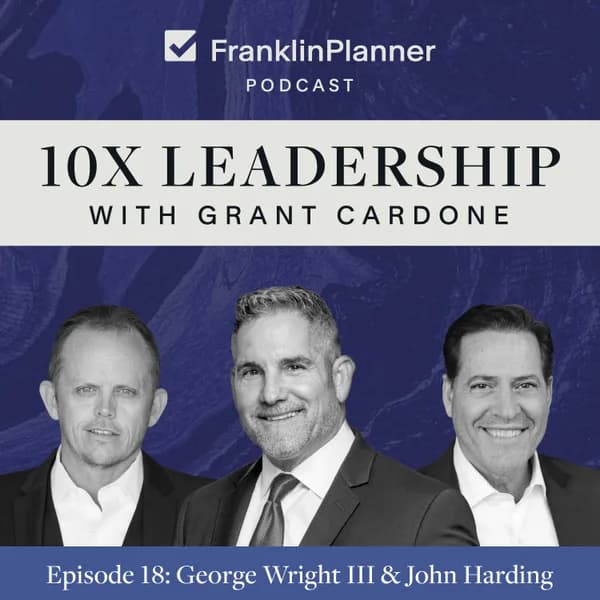
Grant Cardone has spent four decades as a recognized authority on business growth, sales, and wealth, but when George Wright III opened this episode of The Franklin Planner Podcast by asking what matters most to him, the answer had nothing to do with money. It was about how he feels about himself when he goes to sleep. Cardone is the founder and CEO of Cardone Capital, a New York Times bestselling author of 11 books including *The 10X Rule*, creator of the 10X Growth Conference, and the star of *Undercover Billionaire*. He also, as he told George, used a Franklin Planner before the company went public.
What follows is a conversation about personal responsibility, thinking 10X, wealth as a tool, and why leadership is something you do rather than something you are. For anyone building a life around governing values, Cardone's no-excuses approach is a useful mirror.
Grant Cardone on What Matters Most: Self-Respect and Finishing the Task
Cardone's answer starts with the man in the mirror. Before there was a wife, kids, a company, customers, or investors, there was him, and he has to feel good about himself at the end of the day. His illustration was small: after lunch with his daughter at the office, someone loaded dirty plates into the dishwasher without rinsing them. Cardone went back and cleaned them out himself. Not out of moral obligation, he said, but because it was the right thing to do and he would not feel good about himself if he passed it up.
That standard scales up. Cardone sees the opportunity to do any work and complete any task as a gift from God, paid or unpaid. Complete the task, do a good job, go home feeling good about yourself, and only then do you have a shot at being a good father, husband, and community leader. Asked what "the thing" really is, he said the same: finish the task, then start another one. Money follows completion.
Why Personal Responsibility Means Never Blaming Anyone
The 10X philosophy rests on full responsibility, and Cardone takes it further than most. Do not blame other people for anything, he said, even when they are to blame. The reason is practical, not moral. Blame hands away control and turns you into a victim, and a victim cannot fix anything because you cannot fix other people. You can only fix you.
The moment I blame somebody else for my problem, I lost control and I'm a victim.
The list includes the government, the economy, inflation, and parents. The cost, in his words, is blindness: the moment you blame something, you can no longer see the opportunities on the other side of the problem. For Franklin Planner readers, this is Habit 1 in blunt form. Being proactive is a refusal to let circumstances write your day.
How to Think 10X: Inflate Your Dreams and Treat Wealth as a Tool
Cardone admits to what he calls a divine discontent. Twice he became satisfied with his level of success, and both times he ended up deeply unhappy. His warning is aimed at the comfortable middle: people who appear satisfied but never get ahead, then reach 78 without enough money, purpose, or health. His 16-year-old daughter recently asked why the family did not just buy Target. That, he said, is the kind of thinking you want around you.
Dreams, he argued, have not kept pace with inflation. Being a millionaire was the dream 30 years ago; everything costs more now, so the goal has to grow with it. On wealth itself, Cardone traced the word back to its old meaning of being well and called money a tool, not a destination. A person with no way to feed their kids this month cannot honestly be happy, so building wealth is a responsibility. Winning is like a vitamin: success is his duty, whether the game is a real estate deal or a crossword puzzle.
Grant Cardone's Daily Non-Negotiables: Show Up, Write Goals, Outflow First
When George asked about rituals, Cardone started with the basics: wake up, beat the sun when he is at his best, and get a workout in even when his body is beaten up after five days on stage. A mentor gave him one discipline at 25, when grief had him crying constantly: show up even if your eyes are bleeding. He has kept that rule for 42 years.
He also writes his goals every morning and every night on a legal pad, plus a third time whenever he is discouraged. He writes fresh goals rather than rereading old ones, because what he wants today differs from what he wanted a year ago. And he never opens a social app without posting something first. Stay in the outflow, not the inflow, or the feed will consume you.
Why a Planner Should Create Time, Not Manage It
Cardone named a second, more dangerous kind of blind spot: believing something you know to be true that is not. His example was time. He once thought of his day planner as a time manager, then realized the Franklin Planner was built for something else.
The Franklin Planner was designed to create time, not manage it.
That reframe fits the Franklin philosophy exactly. Governing values and a written plan are not there to squeeze more tasks into a day. They are there to create room for what matters most.
Leadership Is Work You Do, Not a Title You Hold
Cardone rarely talks about leadership, and he told George why: he is too busy leading. When he filled a Miami baseball stadium with 34,000 people on Super Bowl weekend in 2019, John Maxwell told him from the stage that every person there came because Cardone led them. Cardone's own description was less romantic. He committed to a date, paid for the stadium, marketed empty seats for a year, insisted people buy tickets, followed up so they showed up, and booked entertainment so they had a good experience. If you call that leadership, fine. He calls it a system of things he had to do.
The same logic runs his family life. He does not chase balance, because balance is usually an attempt to undo a bad decision. He gets the sequence right instead: when he moved to Miami he picked an office first and a house near it, rented both, and kept his cash in the company. At 52 he reconstructed his whole life from zero, and he and his wife homeschooled their daughters so the family could travel together.
You cannot complain and see at the same time. You cannot blame and have vision at the same time.
Action Steps
- Pick one small "right thing" today, like cleaning up something that is not your job, and do it for your own self-respect.
- Catch yourself the next time you blame a person, the economy, or your job, and rewrite the sentence so you are the cause.
- Write your goals by hand tonight and again tomorrow morning. Write new ones each time instead of rereading old ones.
- Before you open any social app, post something of value first. Outflow before inflow.
- Ask whether your current goals have kept pace with the cost of the life you actually want, then inflate them.
Cardone's closing challenge was blunt: it has never been easier to make money than right now, so drop the excuses and get busy. Whatever your appetite for 10X, his core message lines up with the Franklin way. Take responsibility, do the right thing daily, write down what you want, and act. You don't just manage time. You lead your life.