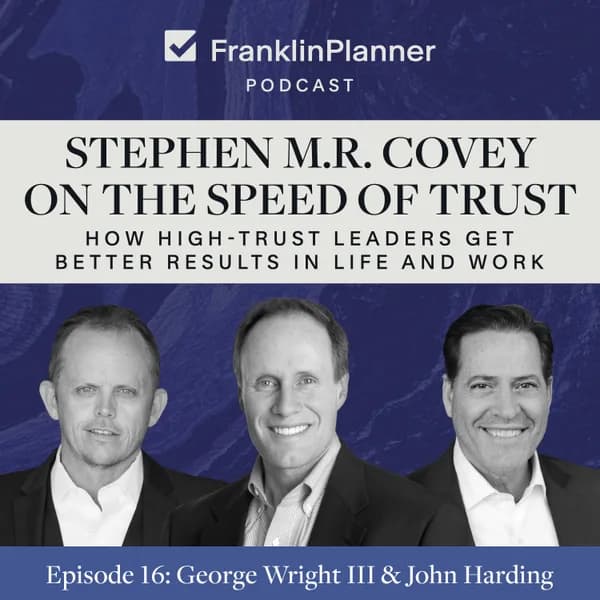
Most leaders treat trust as a soft virtue, something nice to have once the real work is done. Stephen M.R. Covey has spent his career proving the opposite: trust is a hard-edged economic driver that shows up in every relationship, every team, and every income statement, whether you're paying attention to it or not. On this episode of The Franklin Planner Podcast, host George Wright III sits down with Covey, author of the Wall Street Journal bestsellers *The Speed of Trust* and *Trust and Inspire*, former CEO of the Covey Leadership Center, co-founder of FranklinCovey's Global Speed of Trust practice, and son of Dr. Stephen R. Covey.
The conversation moves from the rooftop where a young Covey first learned to begin with the end in mind to the merger that convinced him trust was the most underestimated variable in business, and it ends with three daily actions anyone can start tomorrow.
Stephen M.R. Covey on Growing Up With the 7 Habits
Covey says the thing he's proudest of is being one of Stephen R. Covey's children, and he describes the Covey kids as the first guinea pigs for the principles that later became *The 7 Habits of Highly Effective People*. His father taught each habit separately before ever assembling them: begin with the end in mind, put first things first, seek first to understand. The lesson Covey remembers most came when he was ten or eleven. His father took the family to the roof of a fifteen-story building, pointed to a hole in the ground next door, and, with an architect's blueprint in hand, explained that a taller building already existed on paper. Eighteen months later they returned, and there it stood. That was begin with the end in mind and put first things first in one field trip.
Covey stresses that these are principles, not techniques. They applied when he was eleven, they apply now, and they will apply in fifty years. How you apply them can be timely, but the principles themselves are timeless.
Why Trust Is an Economic Driver, Not Just a Soft Virtue
Covey found his life's work almost by accident. When the Covey Leadership Center merged with Franklin Quest to form FranklinCovey, two organizations that had been arch competitors suddenly shared an office, and trust was low. Nothing moved until they began building trust on purpose. Once they did, the company got more creative, more collaborative, faster, and cheaper. Two insights followed: trust matters far more than anyone estimates, and you can build it intentionally.
Trust is not just a nice, soft, nice-to-have social virtue. It is a social virtue. But it's also a hard-edged economic driver, because it always impacts two outcomes: speed and cost.
When trust drops, everything takes longer and costs more, what Covey calls a low-trust tax. When trust rises, speed goes up and cost comes down, a high-trust dividend. He cites research showing high-trust organizations outperform low-trust ones by 286 percent in total return to shareholders, and the Great Place to Work Institute's 27-year study finding its hundred best companies beat the market by 350 percent. The tax never appears as a line item, but it hides in redundancy, bureaucracy, disengagement, turnover, and churn. Covey compares it to the polarized glasses his fly-fishing guide handed him: the fish were there all along; he just couldn't see them until he put on the glasses.
The Five Waves of Trust: Building It From the Inside Out
Trust, Covey says, always begins from the inside out. He pictures a ripple: the first wave is self-trust, the second is relationship trust built one person at a time, the third is team and organizational trust, the fourth is marketplace trust with customers and stakeholders, and the fifth is societal trust. In a low-trust world, waiting for society to change first means waiting forever. Instead, look in the mirror, become a leader people can trust, and ripple outward.
Diagnose from the outside in, but change, develop from the inside out.
He tells of a leader who did exactly that inside a company with middling trust. She modeled the behaviors, built a high-trust team, and other teams started asking what she was doing. The practice spread sideways, then upward, until the CEO rolled The Speed of Trust out to 45,000 people. It never started with him. It started with one person in her circle of influence.
Why Self-Trust Starts With Make, Keep, Repeat
At a break in one of his presentations, a man pulled Covey aside and confessed he'd spent his life blaming bosses, companies, even his family, before realizing the real problem: he didn't trust himself, and he was projecting that distrust onto everyone else. Covey's advice was to learn to make and keep commitments to yourself. The research shows keeping commitments is the number one trust-building behavior with other people, and it's also the fastest way to build it with yourself. Most of us over-promise and under-deliver to ourselves, turning off the 5 a.m. alarm we swore we'd honor. Covey points to Admiral William McRaven's advice to graduates: if you want to change the world, make your bed. Start with a small commitment, keep it at all costs, and let clarity, integrity, and power grow from there.
How to Extend Smart Trust Without Losing Control
Covey has identified thirteen high-trust behaviors, phrased in two words each: talk straight, demonstrate respect, create transparency, clarify expectations, practice accountability, listen first, keep commitments, extend trust, and more.
So the behavior is common sense, but it's not common practice.
What trips up good people isn't the opposite of a behavior; everyone knows lying destroys trust. It's the counterfeit. The counterfeit of talking straight is spin: telling people what they want to hear, embellishing, sugarcoating. The counterfeit of practicing accountability is pointing the finger. Counterfeit behavior, like counterfeit money, looks real and may even work for a while, but trust goes down.
For the leader who fears delegating because it might not get done right, Covey acknowledges that trusting is a risk, then adds that not trusting is also a risk, and in a world where talent has options, probably the greater one. The answer is smart trust, not blind trust: blend your heart's propensity to trust with your head's analysis of the situation, the stakes, and the person's credibility. Then pair extending trust with two more behaviors, clarifying expectations and practicing accountability. Build the agreement together, delegate outcomes rather than methods, set guidelines and resources, and agree on how they'll report back. The person feels trusted rather than micromanaged, and you haven't lost control; you've shifted it from hovering to the agreement.
Action Steps
- Pick one or two of the thirteen high-trust behaviors that would be highest leverage for you, such as keeping commitments, clarifying expectations, or listening first, and practice them until they're common practice.
- Declare your intent. Whenever you deliver hard news or launch a change, give the why behind the what, because if you don't, people will assign a motive to you, usually a fearful one.
- Find one place to extend more trust this week. Trusted people rise to the occasion, grow, and trust you back.
- Make and keep one small commitment to yourself every day, then repeat.
Covey remembers an early FranklinCovey line: why just manage your time when you can lead your life? Good time management matters, but the broader principle is leading your life, and trust, he says, is the foundation of a life well led. Start by trusting yourself, and everything else ripples out. You don't just manage time. You lead your life.