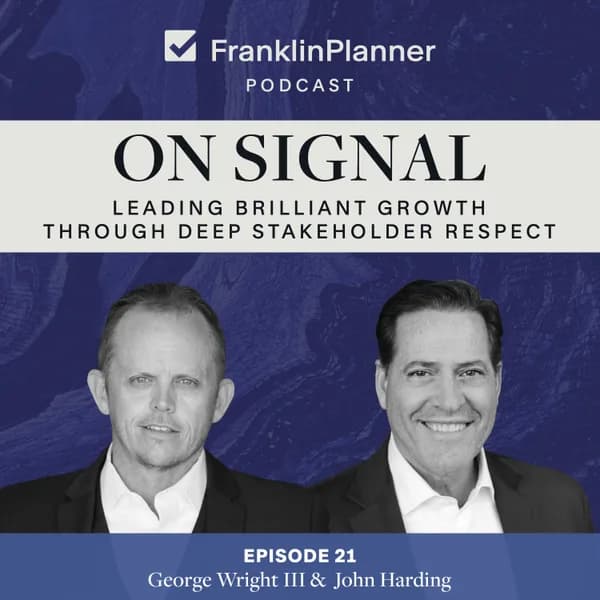
Most leaders would say their people matter. Far fewer treat that belief as a growth strategy with the same rigor they give a financial system or a safety program. In this hosts-only episode, John Harding, owner and board member at Franklin Planner, and co-host George Wright III lay out a bold hypothesis: your greatest opportunity to grow is already sitting inside the relationships around you, and the fastest path forward is a deeper, more invested respect for those stakeholders.
Harding calls the resulting state being on signal. This article unpacks what that means, the two obstacles that keep organizations off signal, and how a planning system built on mission, values, and goals helps close the gap.
Why Deep Respect for Stakeholders Is a Growth Strategy
Harding widens the word stakeholder on purpose. Draw a 360-degree circle around your organization and you will find leaders, teams, employees, customers, patients, clients, partners, investors, suppliers, and communities. Inside every category is a person, and inside every person is a relationship that makes decisions. He argues those relationships are strategically priceless, a competitive advantage most companies gloss over or hand off to HR.
Deep respect for your stakeholders is actually a growth strategy, and people don't think of it like that.
The research he cites backs the claim. Gallup's 2025 State of the Global Workplace links engaged organizations to 23% higher profitability and 18% higher productivity. McKinsey's organizational health research, which measures clarity, alignment, and committed leadership, finds three times the shareholder return. Bain and Company reports that highly engaged organizations outperform peers in revenue growth and customer advocacy.
Harding's point is not that people matter. Everyone agrees they do. The real question is whether you can tap even greater power by showing a deeper level of respect for these relationships, and whether you have a system designed to build trust, increase alignment, and help each stakeholder succeed. Franklin Planner users will recognize the pattern: what you value, you schedule and measure.
Two Obstacles That Keep Organizations Off Signal
Harding names two obstacles that block this growth. Neither is about intent. Both are about translation, commitment, and attention.
The Mission-Strategy-Success Gap
The first obstacle is what Harding calls the mission-strategy-success gap. Gallup reports only 40% of employees strongly agree that their organization's mission makes them feel important. Kaplan and Norton's balanced scorecard research found that only 5% of employees clearly understood strategy, that 85% of leaders discussed strategy for about an hour a month, and that 60% of organizations never linked strategy to budget. Strategy rarely fails from poor intent, Harding says. It fails from poor translation and weak commitment.
He offers four questions to test your own organization. What percentage of your people are aware of the mission, vision, values, and critical goals? Of those, how many are deeply committed? Of those, how many can name the two or three things they are doing today that directly move the mission forward? And the flip side, which is where this episode breaks new ground: how clearly do you, as a leader, understand each stakeholder's own mission, aspirations, and definition of success?
Boston Consulting Group found that companies with alignment between strategy and daily execution show 40% higher profit. That alignment has to run both directions.
The Productivity Avalanche
The second obstacle is the productivity avalanche. Microsoft's 2025 Work Trend Index reports that 68% of employees lack sufficient uninterrupted focus time. University of California, Irvine research shows knowledge workers are interrupted every three to five minutes, and recovering focus takes more than 20 minutes. Time management studies put up to 60% of the workday into low-value activity: digital noise, admin, meetings, email, and alerts.
Wright names the everyday version: task switching, digital overwhelm, and the shallow work that follows. Harding adds one more weakness hiding inside the avalanche, which is the failure to engage goal science. The research behind setting daily goals, following through, and cascading them through a team is proven, yet most organizations leave it on the table. That gap is also the opportunity.
What It Means to Be On Signal
Leaders seeking brilliant growth, Harding says, cannot lead the way they have been leading. The solution requires clarity, rhythm, measurement, leadership, and high-trust reciprocity. He describes the target state this way: an organization is on signal when it is tightly aligned with its mission, vision, values, and most vital goals, and simultaneously aligned with the mission, aspirations, and definition of success of its most vital stakeholders, from their perspective and in real time.
Being on signal is a dual alignment with our mission and with each stakeholder's mission. You bring those together.
That dual alignment unlocks commitment and brilliance. People who feel understood share their best thinking about where the market is going and what to do next. Harding goes further and proposes that every dollar of profit, every cured patient, and every service delivered flows not just through these relationships but from them.
A Rare Opportunity for Leaders
Harding pauses to frame the stakes. If brilliant growth originates in your most vital relationships, if alignment requires clarity about both the organization's mission and the individual's success, and if reciprocity unlocks commitment, then one question remains: is there a system, with the principles and mindset to match, that can actually do this?
How the Franklin Planner System Gets Teams On Signal
Harding's answer is that forty years ago the Franklin Planner introduced a mission, vision, values, and goals engine that ignited the individual and, on the same page and the same day, let that person work on their role within a team. More than 15 million people have used it, and Harding says it has never been more important, because the strategy gap and the productivity avalanche are both worse than they were.
Show your respect, stay with it, and help people succeed. This way you will grow and achieve your goals.
Wright's challenge to listeners is practical. Revisit your personal mission statement. Identify where your organization's strategy is unclear to the people executing it. Look for the specific places where distraction is eating the work that matters. Then adopt a system that pulls what matters most together with productivity, strategy, and goals in one place.
Action Steps
- Run Harding's four questions on your team this week: awareness, commitment, daily connection to the mission, and your own clarity about each stakeholder's definition of success.
- Pick one stakeholder group outside your employees, such as a supplier or key customer, and ask them directly what success looks like for them right now.
- Audit one workday for interruptions and low-value activity, then block uninterrupted focus time in your planner for the work that moves the mission.
- Write or refresh your personal mission statement and put it beside your organization's mission, vision, and values so you can see where they align.
- Shift some of the rigor you already apply to finance or operations toward measuring trust, alignment, and stakeholder success.
Harding's closing invitation is to see where all of your success actually comes from, then shift a little of your rigor, mindset, and investment toward measuring it. The reciprocity will bring brilliance your way. You don't just manage time. You lead your life.