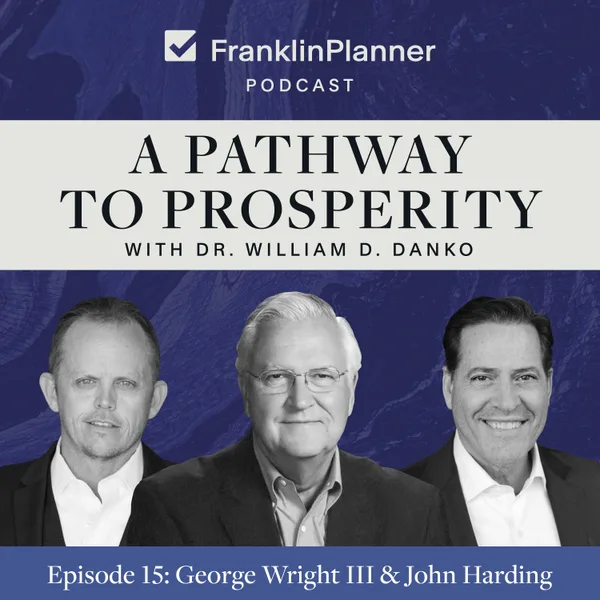
Dr. William Danko wears a stainless steel Rolex he calls his $40,000 watch. He paid less than $2,000 for it in Zurich in 1993, but had he put that money into the S&P 500 instead, it would be worth more than $40,000 today. He keeps it on his wrist as a daily reminder to live below his means. That practical, data-backed wisdom made The Millionaire Next Door, which Danko co-authored with Thomas Stanley, a landmark in how Americans understand wealth. On this episode of The Franklin Planner Podcast, host George Wright III sits down with Danko, a professor emeritus with more than three decades of research on wealth-building behavior, to trace the values behind the numbers.
The conversation covers the habits of ordinary millionaires, the Golden Rule as a pathway to true prosperity, and the findings of his later book, Richer Than a Millionaire, on why some wealthy people are miserable while people of modest means are fulfilled.
William Danko on the Roots of a Value-Driven Life
Danko's worldview was shaped by loss and by care. His father, a Navy veteran of the South China Sea who came home from World War II with a 70 percent disability, died at 38 when Danko was five. His mother, a widow with a high school education, later cared for his brother Tony, who became a quadriplegic in his early twenties. When she suffered a stroke in 1996, the same year The Millionaire Next Door was published, Danko reevaluated his priorities. Keeping Tony out of a nursing home went to the top. He bought his brother a house with his book royalties, hired aides during the week, served as the aide himself every weekend for twenty years, and traded his Mercedes for a wheelchair van. He would do it again in a heartbeat.
Those weekend conversations with a college-educated brother who could not scratch his own nose were about what life is really for. They are also why Danko created the Milton and Mary Danko Golden Rule Award in his parents' names in 2001, a $2,000 scholarship, half to the student's tuition and half to a charity of their choice, awarded not for grades or money but for generosity with time.
What The Millionaire Next Door Still Gets Right
Danko met Stanley as a student in a consumer behavior class and was invited into Stanley's first study of the affluent market in 1973. He went on to a PhD at Rensselaer Polytechnic Institute and 31 years on the faculty at the State University of New York at Albany. His mother had told him to stay in school; he took her literally.
Asked what still holds true after decades of research, Danko returns to one mantra.
When you're young, you work for money, and when you're old, money works for you.
The mechanism is simple. Build an entrepreneurial spirit that creates income, then get it through your head that you must be a saver, which means being frugal. Danko's own rule was to keep living like a graduate assistant long after he stopped being one: used cars, no flamboyant lifestyle, steady investing across diverse assets. The reward was three children who left college debt-free and launched careers as a mechanical engineer, a university mathematician, and a systems analyst. When he asked his daughter why she was putting herself through a PhD with three kids at home, she said, "Dad, I saw you do it." Parents are role models, and children are watching.
Why Self-Imposed Economic Scarcity Matters More Than Ever
Wright raises a theme that runs through the book and through the Franklin Planner philosophy of stewardship and long-term thinking: self-imposed economic scarcity. Danko says it applies more now than ever, because America has a bigger-faster-better consumer economy that tells you to replace everything every couple of years. His own physician, after reading the book, moved his family out of a high-end neighborhood so his kids would not grow up needing more because their friends had more.
The same discipline applies to giving. One of the book's key chapters covers what Danko calls economic outpatient care: subsidizing adult children with regular gifts until they build a cycle of dependency. He is generous with his children, but they never ask and never know when it is coming.
How the Golden Rule Leads to True Prosperity
Danko credits Benjamin Franklin's 1758 essay The Way to Wealth for the idea at the center of his later work: no matter how frugal, prudent, and industrious you are, you do not have true wealth unless you are charitable. Once wealth is built, he says, there are only four things to do with it. Spend more on yourself, which frugal people will not. Give it to your kids and risk deadening their ambition. Die with a huge estate tax. Or be charitable with your money and your time.
Richer Than a Millionaire, written with colleague Richard Van Ness after Tony's death in 2015, tested that idea with a subjective well-being scale from the psychology literature. About 20 percent of the very affluent scored low. They are rich and miserable. Meanwhile many people of modest net worth scored high. The associations are strong: nearly everyone who reported being both rich and very happy also said God was central to their life, and across Judaism, Islam, and Christianity, the faithful tend to be givers.
As a giver you actually become wealthier because you're finding there is a very good reason that you have the money that it could be used for the benefit of others.
Are You at Peace With Your Soul?
When Wright asks what question Franklin Planner readers should ask themselves to plan with purpose rather than just for income, Danko offers one: are you at peace with your soul? A yes correlates strongly with life satisfaction. A no usually means you are angry at the world over things you cannot control. He points to Reinhold Niebuhr's Serenity Prayer as the filter. You cannot change the economy. You can change your diet, your exercise, your course of study, and your spending.
Follow your dreams, but don't forget to make a living.
For families, his prescription is equally concrete. Show children the power of compound interest early. Sit down at the dinner table with no phones and talk about the day and about aspirations, because the family is the world's smallest classroom. Danko grew up in a single-parent household, but there was love and an expectation of being a giver. Fifty-one years of marriage and six grandchildren later, he calls it a blessed life.
Action Steps
- Write down one purchase you are considering and calculate what that money would be worth in 25 years invested. Decide with the number in front of you.
- Pick one area of lifestyle inflation to reverse this month, whether a car, a subscription, or a neighborhood standard you are quietly trying to match.
- Schedule a recurring gift of time, not just money, to a cause you believe in, and put it in your planner like any other commitment.
- Hold one phone-free family dinner this week and talk about aspirations, not logistics.
- Ask yourself honestly whether you are at peace with your soul, and name one thing within your control to change if the answer is no.
Franklin closed The Way to Wealth with townspeople who heard the message, agreed with it, and then practiced the contrary. Danko's research has spent 40 years confirming that the answers have not changed: be frugal, be prudent, be industrious, be charitable. The only variable is whether you will do it. You don't just manage time. You lead your life.