Shawn Moon
Chairman and CEO of Zerorez, Former FranklinCovey EVP
Chairman and CEO of Zerorez who spent more than 25 years at FranklinCovey and still keeps a Monday 8:00 a.m. appointment with himself.

About Shawn
Shawn Moon is the chairman and CEO of Zerorez, a position he has held since September 2017 after serving on the company's board of directors. He has more than 35 years of executive experience, including over 25 years with the FranklinCovey Company, where he was executive vice president with responsibility for the company's direct offices and operations globally. He was also a principal with Mellon Financial. Since becoming CEO he has transformed Zerorez, increasing revenue and profitability and securing private equity funding from Banner Ventures, work that made him a finalist for EY Entrepreneur of the Year. He is a Wall Street Journal bestselling author.
Moon joined Stephen R. Covey's organization in 1988, before The 7 Habits of Highly Effective People was published, when his job was, in his words, smiling and dialing. He has since taught and lived those principles with Fortune 500 companies, government organizations, and leadership teams on every continent except Antarctica. His current project is a book built on interviews with a hundred CEOs and executive leaders, including a sitting governor and a member of the British Parliament, each asked what single lesson they would pass on to the people they love. He and his wife, Michelle, live at the base of the Wasatch Mountains and have four children and seven grandchildren.
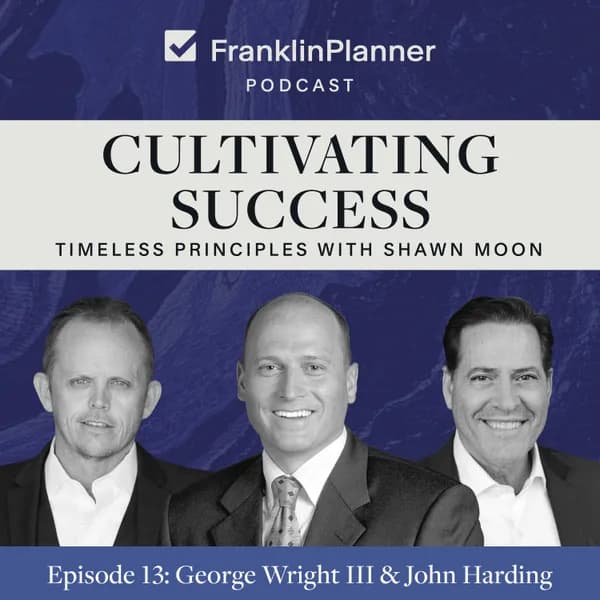
On The Franklin Planner Podcast, Moon sat down with George Wright III and John Harding, both of whom reported to him during his FranklinCovey years, for a conversation about the two Covey habits that fix almost everything when a week feels off. He explained why the seven habits are natural laws that work whether you believe in them or not, walked through his 30-10 rule for weekly planning and the daily private victory, and previewed the themes emerging from his hundred CEO interviews: generosity, humility and followership, dignity as strategy, grace in the long game, and above all empathy.
Key ideas from Shawn’s conversation
Don't try to live all seven habits at once; do two things.
When Moon asked Stephen R. Covey how anyone could live all seven habits, Covey told him to do two things. Moon's two are a weekly planning session and a daily private victory. Whenever he feels edgy, depleted, or quick to take offense, he can trace it to a failure of his own in habits one, two, three, or seven.
Give yourself the gift of 30 minutes once a week, then 10 minutes a day.
Every Monday at 8:00 a.m. Moon reviews his mission, lists the roles he is playing, and asks what one thing in each role would make an impact this week. Those big rocks go into the schedule first. Each evening he spends five to ten minutes reviewing what got done and rescheduling any rock that dropped.
Principles are natural laws; people don't break them, they break themselves against them.
Covey never claimed to invent the principles of effectiveness. Like gravity, they govern whether you acknowledge them or not: keep demonstrating untrustworthy behavior and people stop trusting you. Moon says the leaders who fail are sent to a seminar to be fixed and never buy in. The ones who succeed step back weekly and ask themselves tough questions.
A daily private victory is four checks and 30 to 60 minutes.
Moon frames it as four checks: sleeping, eating, and exercising well; engaging his brain instead of losing an hour to reels; deliberately building the relationships that matter; and reconnecting with his sense of purpose. It need not touch all four. His longest-running example is Friday date night with his wife, kept for thirty-seven and a half years.
Not one of 100 CEOs said they wished they had generated more shareholder value.
Moon asked each leader what single lesson they would pass on to the people they love. Results still matter, he insists: no margin, no mission. But the answers are all ways of getting there, and they are coalescing into twelve themes, among them generosity, humility and followership, dignity as strategy, grace in the long game, and above all empathy.