Misty Howard
Historian-Enthusiast, Creator and Host of Faith Ignited
Host of Faith Ignited, bringing the founding era to a younger generation through the lives, values, and overlooked stories of figures like Benjamin Franklin.

About Misty
Misty Howard is a historian-enthusiast and podcast host who brings a youth-oriented voice to timeless values and historical wisdom. She is the creator and host of Faith Ignited, a podcast built on immersive, real stories from history seen through the lens of faith. Her work centers on the lives of influential historical figures, especially from the founding era of the United States, and on connecting their personal values to modern leadership, mission-driven living, and character development. She has made it her mission to bring that era to a younger generation, telling the historical truths that mainstream narratives often overlook.
Howard's method blends historical research, faith-based insight, and practical application aimed at younger audiences. Benjamin Franklin is her prime example of a pattern she sees across history: the most successful people are rarely born into great circumstances, and what sets them apart is determination. She traces Franklin from a Boston print shop, where a twelve-year-old apprentice packed bread and raisins for lunch and spent the break reading, through the directionless years in London, to the ocean voyage home where he evaluated what he really wanted from life. She emphasizes self-improvement, purpose, and the discipline of writing down what you value, and she argues that principles do not change, so life gets better when we conform to them.
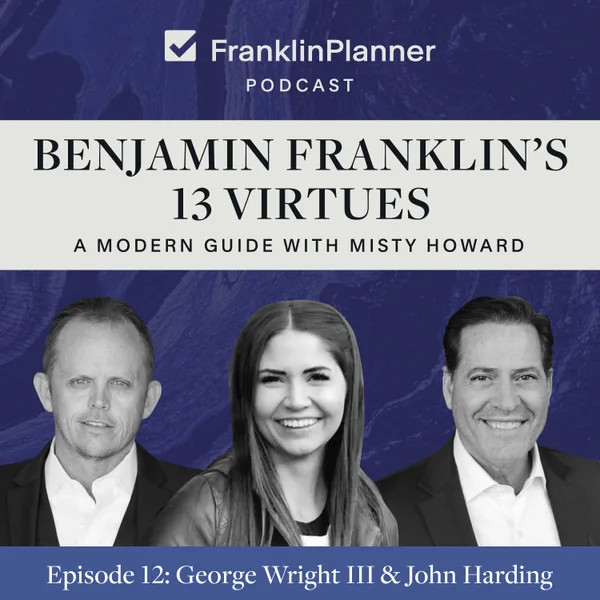
On The Franklin Planner Podcast, Howard joined co-hosts George Wright III and John Harding for a conversation about Benjamin Franklin's 13 virtues and the self-evaluation process behind them. She walked through Franklin's early years under an indenture to his brother, his pseudonymous Silence Dogood essays at sixteen, and the lost years between eighteen and twenty that ended with him ranking thirteen virtues so each would make the next easier to practice. Harding connected that process to the productivity pyramid at the base of the Franklin Planner system, and Howard closed on what she calls Franklin's greatest discovery: the correlation between virtue and happiness.
Key ideas from Misty’s conversation
The most successful people in history are rarely born into great circumstances.
Howard sees the same pattern across history: determination, not circumstance, is what separates them. Franklin had about two years of formal schooling, was the fifteenth of seventeen children, and was indentured to his brother at twelve. He treated reading and writing as the principal means of his advancement and bought books with the lunch money he saved.
Franklin's 13 virtues came out of a deliberate self-evaluation, not a lucky temperament.
Between eighteen and twenty Franklin lived his most directionless years, adopting the values of the company he kept. The turning point was a distraction-free voyage home, where he worked out what he wanted from life. Over the next two years he settled the virtues and a system for living them, one per week, tracked in a little book.
Greatness is only achieved by taking the harder course.
Howard says today's youth are taught to take the easiest path and stretch childhood as long as possible, and that society loves victims. Franklin was beaten by his brother and could have stayed a victim of his circumstances. Instead he took full responsibility, left the apprenticeship, and moved to Philadelphia.
Virtue and happiness are correlated, and Franklin proved it on himself.
Howard calls this Franklin's greatest discovery. He never reached moral perfection and admitted it, yet wrote that the endeavor made him a better and happier man than he otherwise would have been. Self-development is a means to an end: we improve ourselves so we can help others, and we are happier when we are thinking about others.
Reflection will not happen to you; you have to make the time on purpose.
Franklin had a long ocean voyage with nothing to distract him. Howard says the rest of us have to set aside everything else, block screen-free time, and write down what we truly value and the qualities we want to develop. Then set goals that move you toward that person, and track one virtue for a week.