Carl Pullein
Productivity Coach, Creator of the Time Sector System
Thirty years studying time management, a decade all-in on digital, and a three-month experiment with a Franklin Planner he still hasn't ended.

About Carl
Carl Pullein is a time management expert and productivity coach with a global audience. He has spent thirty years studying the field and runs a blog, a YouTube channel, and a podcast from South Korea, where he has lived for twenty-three years. He is the creator of the Time Sector System and the COD task management system, a three-step method — Collect, Organize, Do — distilled from every twentieth-century time management book he could find, back to the 1950s. His teaching starts with a distinction: input is not within your control, but your time is.
Pullein's interest began in middle school, scheduling exam revision with colored pens. Sales brought it back. After a manager called him the most disorganized person he had ever met, he read Hyrum Smith's The 10 Natural Laws of Successful Time and Life Management and started using a Franklin Planner around 1992. In 2009 his first iPhone pulled him fully digital for more than a decade. Around 2015 to 2017 he watched people spend 50 to 60 percent of their day organizing; his target is roughly 95 percent doing and 5 percent organizing, about fifteen to twenty minutes a day, on paper or on screen.
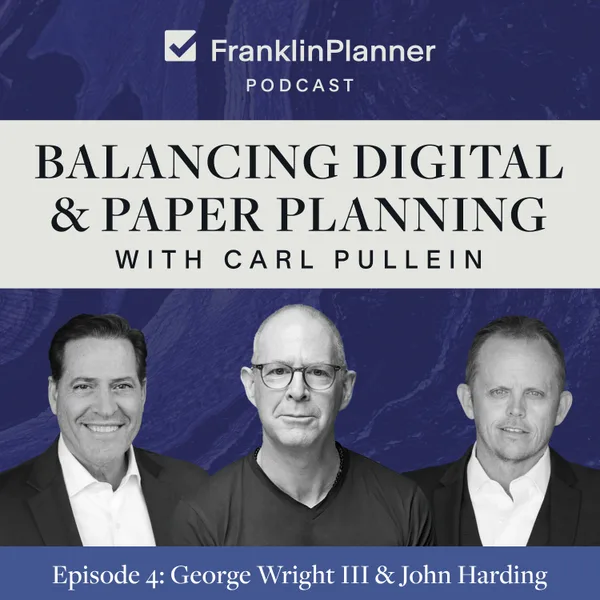
Pullein joined John Harding and George Wright III for a conversation about the experiment that brought him back to paper planning. He had bought a new Franklin Planner in October, committed to three months, and six months later had not stopped. He explained why digital lists go numb on the screen, why a paper page shows you an impossible day before you live it, and how moving his YouTube planning to paper tripled his views in a month. His landing spot: thinking and planning happen on paper, and execution — scheduling links, meeting invites, a quick text — belongs to technology.
Key ideas from Carl’s conversation
The stuff coming in will never stop, so manage your time instead of your tasks.
Pullein points to Queen Elizabeth II, who did her red government boxes on the morning of the day she died. Emails and Slack messages are outside your control. Your twenty-four hours are not. Start with yourself, not your work, or you end up unfulfilled and living with low-grade anxiety.
Aim for 95 percent doing and 5 percent organizing.
When productivity apps exploded around 2015 to 2017, Pullein watched people spend half their day organizing. Run each captured item through three questions — what is it, what do I need to do, when am I going to do it, if at all — and a correctly set-up system needs about twenty minutes a day.
A paper planner warns you when a day is impossible; a digital list never will.
Pullein's clients were carrying sixty or seventy tasks on a daily digital list. A Franklin Planner does not have sixty spaces, and the day's calendar sits beside the prioritized task list, so seven hours of calls tells you immediately that twenty tasks will not fit.
Planning on paper tripled Pullein's YouTube views in a month.
He moved his video planning from digital to paper with no other change, and weekly views went from about three thousand to ten thousand. On paper he was more creative and more fluid with the story; digitally, everything had been bullet points. Text on a screen always looks the same.
Plan tomorrow the night before, and close the planner to end the day.
Sitting down with the planner away from the screen forces a few minutes of real thinking about what needs to happen tomorrow. Pullein plans at night because he sleeps better and enjoys the evening more. Zipping the binder closed is the ritual that says the day is done.